

Wetlands filled with alligators, endless horizons of sawgrass and mysterious mangrove forests. Everglades National Park is one of the largest national parks in the United States and home to one of the most unique ecosystems on our planet.
If you are planning a trip to Florida, this UNESCO World Heritage Site should definitely be on your itinerary.
But how do you get there? Which entrance should you choose? What should you see? And how can you save money on admission?
A Wild History
Forget the word “swamp.”
Writer and conservationist Marjory Stoneman Douglas famously described the Everglades as a “River of Grass.”
And that description makes much more sense once you see the landscape for yourself.
The Everglades are essentially an enormous, slow-moving sheet of water flowing south from the Lake Okeechobee region towards Florida Bay. The water is often very shallow, creating the seemingly endless landscape of sawgrass that has become one of the symbols of southern Florida.
During the 19th and early 20th centuries, people attempted to drain large parts of the Everglades to create farmland and make space for growing towns and cities.
Canals were constructed, wetlands were altered and the natural flow of water was dramatically changed.
Fortunately, conservationists began fighting to protect what remained.
One of the most important was Ernest F. Coe, often referred to as the father of Everglades National Park.
After years of campaigning, Everglades National Park was officially established in 1947, with President Harry S. Truman attending its dedication.
Today, the protected landscape provides a home for hundreds of bird species as well as manatees, the endangered Florida panther, crocodiles and, of course, the animal most visitors hope to see:
the American alligator.
TikTok moment
Gator
How Far Is Everglades National Park?
The Everglades cover a huge area of southern Florida, yet parts of this wilderness lie surprisingly close to major cities.
- From Miami: Depending on where you start and which entrance you choose, the journey generally takes around an hour. Shark Valley is one of the most convenient areas to reach from Miami.
- From Orlando: Expect a considerably longer drive south. Depending on traffic and your chosen entrance, the journey takes roughly four hours or more, making an overnight stay in South Florida a much better option than a rushed day trip.
Entrances to the Park: Where Should You Go?
This is important when planning your visit.
Everglades National Park does not have one central entrance from which you can simply drive everywhere.
There are several separate areas, and they are not connected to each other by roads inside the park.
That means you need to choose your entrance according to what you actually want to experience.
Shark Valley – The Best Choice If You Have Limited Time
If you are coming from Miami and only have part of a day, Shark Valley is one of the easiest ways to experience the Everglades.
The main attraction is a roughly 15-mile (24 km) paved loop through the wetlands.
You can explore it in several ways:
- on foot,
- by bicycle,
- or on the Shark Valley tram tour.
Around halfway along the loop stands the Shark Valley Observation Tower, offering panoramic views across the seemingly endless River of Grass.
This is also an excellent area for wildlife watching.
Depending on the season and conditions, alligators can often be seen remarkably close to the trail.
And no – despite the name, you will not find sharks swimming through Shark Valley.
Ernest F. Coe Entrance & Flamingo – Deeper Into the Everglades
If you have more time, the entrance near Homestead allows you to explore a much larger section of the park.
From the Ernest F. Coe Visitor Center, the road continues for approximately 38 miles (60 km) through the Everglades to Flamingo, near the coast of Florida Bay.
This is not just a drive from point A to point B.
Along the way, you can stop at numerous viewpoints, boardwalks and short nature trails, each revealing a slightly different ecosystem.
You will pass through sawgrass marshes, hardwood hammocks, wetlands and eventually mangrove environments closer to the coast.
If you want to understand how diverse the Everglades really are, this is the part of the park where it becomes obvious.
Gulf Coast – Into the Mangroves
On Florida’s western side, Everglades City provides access to the Gulf Coast section of the national park and the wilderness of the Ten Thousand Islands.
Here, the experience changes completely.
Forget observation towers and long walks through sawgrass.
This is a world of water.
Mangrove islands, narrow waterways and coastal wilderness stretch towards the Gulf of Mexico.
One of the best ways to explore this part of the Everglades is from the water – by kayak, canoe or boat.
It feels very different from Shark Valley or the road to Flamingo.
And that is perhaps the most important thing to understand about the Everglades:
There is no single Everglades landscape.
The national park is a vast mosaic of wetlands, sawgrass prairies, mangrove forests, coastal environments and small islands – and each entrance reveals a different side of Florida’s wilderness.
Where Can You Experience the Everglades Completely FREE?
Standard admission to Everglades National Park is $35 per vehicle, with the pass valid for seven consecutive days.
But if you are travelling on a tighter budget, there are some excellent alternatives where you can experience the wild side of South Florida, see alligators in their natural habitat and pay absolutely nothing for admission.
Big Cypress National Preserve – Oasis Visitor Center
Immediately next to the Everglades, along the famous Tamiami Trail (US 41), lies Big Cypress National Preserve.
And if seeing alligators is high on your Florida wish list, this is a place worth stopping.
Behind the Oasis Visitor Center, a boardwalk overlooks a canal where alligators are frequently seen resting in or beside the water.
Depending on the conditions and time of year, you may see several of them during a single stop, along with herons, egrets and other wading birds.
The best part?
There is no entrance fee to visit Big Cypress National Preserve.
H.P. Williams Roadside Park
Another easy stop along the Tamiami Trail is H.P. Williams Roadside Park.
This small roadside area has a short boardwalk overlooking the water, where alligators and birds can often be spotted.
It does not take long to visit, which makes it an ideal stop if you are driving between Miami and Florida’s Gulf Coast and want to experience some of the local wildlife along the way.
And once again, there is no admission fee.
Loop Road – Into the Wild Side of Big Cypress
If you want something a little more adventurous, take a detour onto Loop Road (CR 94).
This roughly 24-mile (38 km) scenic road runs through the forests and wetlands of Big Cypress and feels very different from the busy highways of South Florida.
Drive slowly and keep your eyes open.
Depending on water levels, weather and the season, you may spot alligators beside the road, wading birds in the wetlands and other wildlife hidden among the cypress trees.
The road also offers a completely different perspective on this ecosystem. Instead of viewing the landscape from a visitor center or observation platform, you are driving directly through it.
Important: Conditions on Loop Road can change, especially after heavy rain. Check current road conditions before setting out, drive carefully and never approach or feed wildlife.
Our Tip
If you are driving the Tamiami Trail, combine all three stops:
Oasis Visitor Center → H.P. Williams Roadside Park → Loop Road
It is a great way to experience the wetlands and wildlife of South Florida without paying an additional national park entrance fee.
Just remember that Big Cypress National Preserve is not the same as Everglades National Park. It is a separate protected area with its own landscapes and character – and it is well worth exploring in its own right.
What Should You Definitely See and Experience?
Anhinga Trail
Located near the Ernest F. Coe entrance, the Anhinga Trail is a short and easy trail of less than a mile, partly following boardwalks above the wetlands.
Despite its short length, it is one of the best places in the Everglades for wildlife watching.
Alligators can often be seen resting remarkably close to the boardwalk, while anhingas, herons, turtles and other wetland wildlife are commonly found around the trail.
What makes the experience so memorable is just how close the wilderness feels.
You are not looking at the animals through glass or from a distant observation platform. You are walking directly through their natural habitat.
Of course, these are still wild animals. Never approach, touch or feed an alligator, and always follow National Park Service guidance and posted warnings.
Take an Airboat Ride
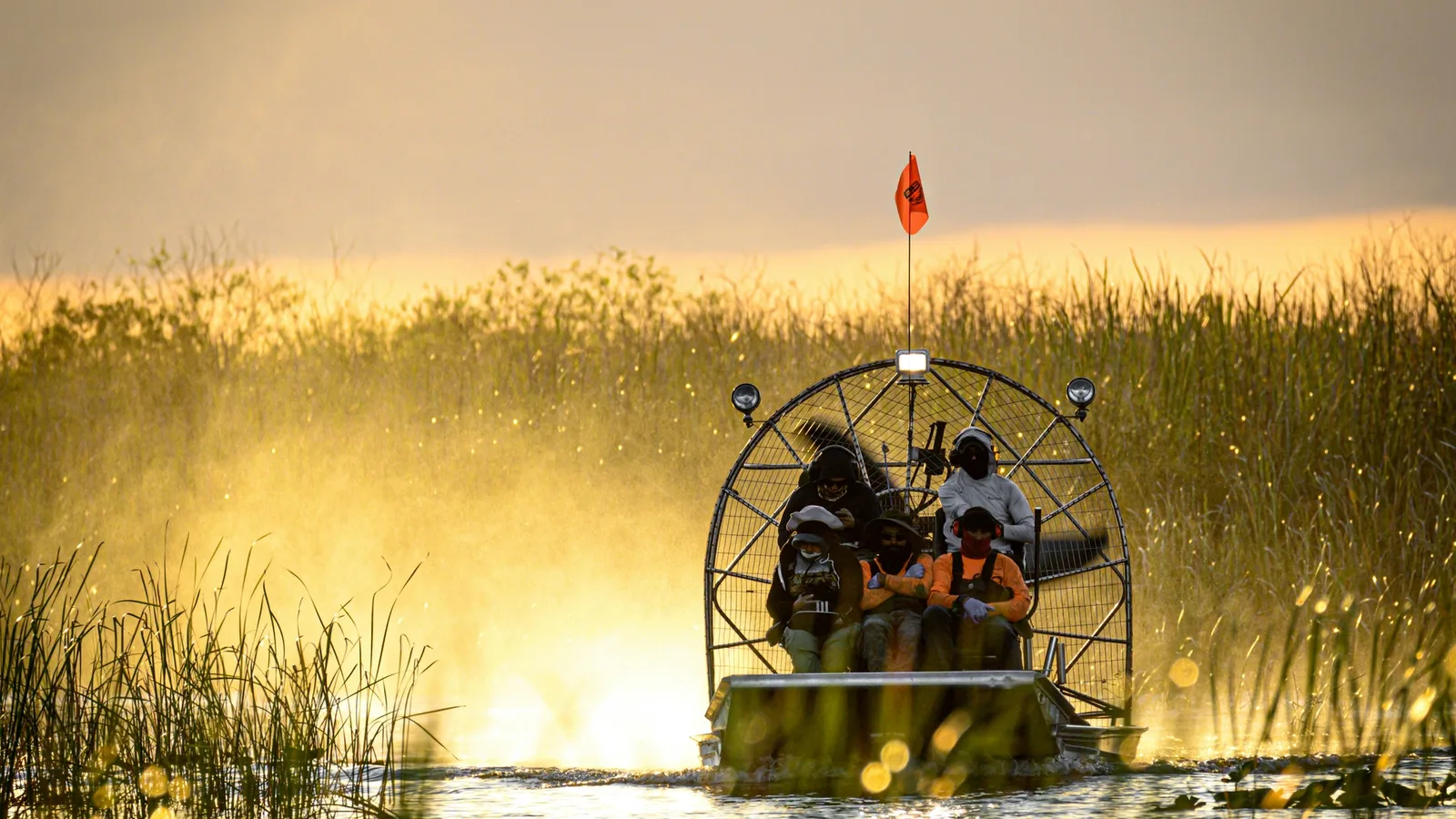
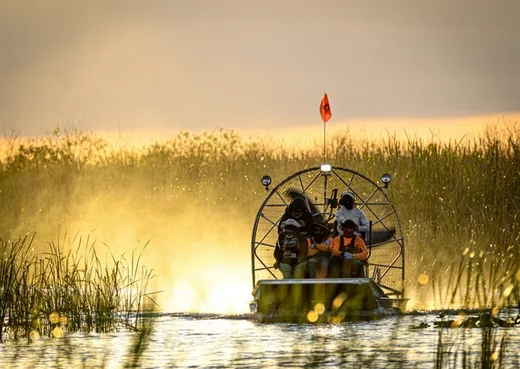
Few experiences are as closely associated with South Florida as racing across the wetlands on an airboat.
The huge propeller behind you roars into life, the boat begins gliding across incredibly shallow water and suddenly you are travelling through a landscape that would be almost impossible to reach with a conventional boat.
It is loud.
It is fast.
And it is unmistakably Florida.
However, there is one important thing to know before you go:
Airboat tours are generally not operated throughout the interior of Everglades National Park itself.
Instead, authorized airboat businesses operate in designated areas near the park, particularly along the Tamiami Trail.
Who Offers Airboat Rides and How Much Do They Cost?
Airboat rides are among South Florida’s most popular tourist experiences, so there are several operators around the Everglades.
Prices vary considerably depending on the company, length of the ride, group size and whether you choose a shared or private tour.
For that reason, we recommend checking current prices directly with the operator before your visit rather than relying on older prices found in travel blogs.
How Does an Airboat Actually Work?
An airboat looks very different from a conventional motorboat.
Instead of a submerged propeller, it is powered by a large aircraft-style propeller mounted at the rear of the boat, usually driven by an aircraft or powerful automotive engine.
This design allows the boat to travel through extremely shallow water and marsh vegetation where an ordinary boat could not operate.
Steering is controlled by rudders positioned behind the propeller, which redirect the airflow and turn the boat.
Traditional airboats also do not handle like normal boats. Many lack a conventional reverse system, and stopping relies largely on reducing power, drag and the skill of the operator.
That is one reason why these boats should always be operated by experienced professionals.
And once the engine starts, you will understand something else immediately:
they are extremely loud.
Hearing protection is normally provided and is definitely worth using.
For us, an airboat ride is not simply transportation through the wetlands.
It is part of the Florida experience itself.
Only licensed operators are permitted to run airboat tours within designated areas of Everglades National Park. Other companies operate on nearby private waters or Native American lands – which does not necessarily make the experience any less exciting.
A Traditional Everglades Airboat Experience
Some of the oldest airboat operators along the Tamiami Trail have been taking visitors into the Everglades since 1945.
These tours offer a classic South Florida experience, taking passengers across open sawgrass wetlands and through areas surrounded by subtropical vegetation.
- What to expect: A traditional airboat ride through the Everglades, combining open wetlands with more enclosed sections beneath the trees.
- Price: A shared 40-minute tour costs approximately $39 per adult and $21.40 per child. A short educational wildlife presentation is also included.
- Additional fees: Because the tour enters a designated area within Everglades National Park, an additional $8 federal entrance fee may apply if you do not already have a valid park pass.
Tip: Prices and entrance fees can change, so always check the operator’s current rates and conditions before your visit.
2. Gator Park
What is it?
Gator Park is a popular and well-organised airboat attraction located within easy reach of Miami. One of its biggest advantages is the frequency of departures – airboats generally leave every 20 to 30 minutes, so you usually do not have to wait very long.
This makes it a convenient option if you are visiting the Everglades as a day trip from Miami and do not want to plan your entire day around a fixed departure time.
Price:
A standard ticket costs around $40 per person. The ticket usually includes both the airboat ride and admission to the wildlife show afterwards.
Additional fees:
An additional $8 National Park entrance fee may apply.
Prices and inclusions can change, so we recommend checking the current conditions directly with the operator before your visit.
3. Everglades Holiday Park
What is it?
Everglades Holiday Park is a larger and more modern attraction located further north, making it particularly convenient for visitors staying around Fort Lauderdale.
The park became widely known through the television series Gator Boys, which followed alligator rescuers and helped turn the location into one of South Florida's best-known airboat attractions.
The experience combines an airboat tour with an alligator presentation, so it is aimed at visitors looking for more than just a ride through the wetlands.
Price:
A complete package costs approximately $42 for adults and $30 for children.
The package typically includes:
- an approximately 60-minute airboat ride,
- the Gator Boys wildlife presentation,
- and a complimentary group photograph.
The airboats can accommodate larger groups, making this a somewhat different experience from smaller and more traditional airboat operators along the Tamiami Trail.
Which one should you choose?
If you are staying in Miami, Gator Park is a convenient option thanks to its location and frequent departures.
If you are closer to Fort Lauderdale and want a more organised attraction combining an airboat ride with additional entertainment, Everglades Holiday Park may be the better choice.
And if your priority is a more traditional airboat experience with less emphasis on the attraction around it, one of the smaller operators along the Tamiami Trail may suit you better.
What Animals Live in the Everglades?
The Everglades are about much more than just alligators.
The combination of freshwater flowing south from the interior of Florida and saltwater from Florida Bay has created an incredibly diverse ecosystem. Wetlands, mangrove forests, coastal waters and small islands provide habitats for an extraordinary variety of wildlife.
For many visitors, wildlife watching becomes one of the highlights of the entire trip.
American Alligator
The American alligator is the undisputed symbol of the Everglades.
South Florida is home to a large alligator population, and the Everglades provide ideal habitat for these impressive reptiles.
Most of the time, however, they are far less dramatic than you might expect.
You will often see them lying almost completely motionless beside the water, warming themselves in the Florida sun. Others remain almost entirely submerged, with only their eyes and nostrils visible above the surface.
And that is precisely what makes spotting them in the wild so exciting.
At places such as the Anhinga Trail, Shark Valley and Big Cypress, you can sometimes see alligators surprisingly close to trails and boardwalks.
They may look relaxed, but never forget that these are powerful wild animals.
Always keep a safe distance, never feed them and never attempt to touch or approach them – even if they appear completely motionless.
American Crocodile
Unlike the American alligator, the American crocodile prefers brackish and saltier coastal waters.
In the Everglades, your best chance of spotting one is in the southern part of the park, particularly around Flamingo and Florida Bay.
American crocodiles are generally lighter in colour than alligators and have a narrower, more pointed snout.
They are also much less commonly seen, which makes spotting one in the wild a particularly special experience.
West Indian Manatee
The calm coastal waters around the Everglades are also home to West Indian manatees – enormous but peaceful aquatic mammals sometimes affectionately called “sea cows.”
During the cooler months, manatees seek warmer waters and can sometimes be spotted in canals, bays and marinas along the coast.
One of the places worth checking is the marina at Flamingo, where visitors occasionally see manatees swimming close to the docks.
They can be surprisingly difficult to spot at first. Sometimes the only sign is a nose briefly appearing above the surface for a breath.
Florida Panther
Far more elusive is the Florida panther.
This endangered big cat is one of the rarest animals in North America and survives primarily in South Florida.
Seeing one in the wild is extremely unlikely.
In fact, during a normal visit to the Everglades, you are much more likely to encounter road signs warning drivers about panthers than the animal itself.
But knowing that these secretive predators still roam the wilderness of South Florida adds another dimension to the Everglades.
Wildlife You May See From an Airboat
During an airboat ride, the captain will usually keep an eye out for wildlife hiding among the sawgrass and waterways.
Apart from alligators, you may encounter turtles and an impressive variety of birds.
The Everglades are particularly famous for their birdlife.
You may spot elegant herons and egrets standing motionless in the shallows, colourful purple gallinules moving across aquatic vegetation, and vultures circling overhead or waiting nearby for an opportunity to feed.
Exactly what you see will depend on the season, weather, water levels and a fair amount of luck.
And that unpredictability is part of the experience.
The Everglades are not a zoo. Nothing is guaranteed – and that is precisely what makes seeing these animals in the wild so memorable.
Interesting Fact: The Burmese Python Invasion
The Everglades are currently facing a serious ecological problem caused by an unexpected predator – the Burmese python.
These enormous snakes are not native to Florida. They were originally brought to the United States through the exotic pet trade, and animals that escaped or were deliberately released eventually established a breeding population in South Florida.
Hurricane Andrew in 1992 is often associated with the story of their spread, although the invasion cannot be attributed to the hurricane alone. Burmese pythons had already been recorded in the Everglades before then, and released or escaped pets are considered an important source of the established population.
Today, Burmese pythons have spread across large parts of the Greater Everglades ecosystem.
They can grow to more than 5 metres (16 feet) long, and their size, camouflage and ability to survive in the wetlands make them extremely difficult to control.
Their impact on native wildlife has been significant.
Burmese pythons prey on a wide range of animals, including birds, rabbits, raccoons and other mammals. Large individuals are even capable of attacking and eating alligators.
With few natural predators once fully grown, they have become one of the most problematic invasive species in South Florida.
Florida Python Challenge
Florida has taken some unusual measures to reduce their numbers.
One of the best known is the annual Florida Python Challenge, during which registered participants compete to remove invasive Burmese pythons from the wild.
The event is not simply a bizarre Florida competition.
Its main purpose is to raise public awareness about invasive species while helping remove pythons from the Greater Everglades ecosystem.
And if you are wondering whether you are likely to encounter a five-metre python during an ordinary visit to the Everglades – probably not.
Despite their size, Burmese pythons are masters of camouflage and can be surprisingly difficult to spot in the dense vegetation.
Thousands may live in the wetlands while remaining almost invisible to most visitors.
Airboats Were Originally Designed for Ice, Not Swamps
Airboats may be one of the most iconic symbols of the Florida Everglades today, but their origins have little to do with tropical wetlands.
Early propeller-driven boats were developed in the early 20th century in Canada and the northern United States, where inventors experimented with vehicles capable of travelling across frozen rivers, ice and shallow water.
Florida later became one of the places where the concept truly found its perfect environment.
With vast areas of extremely shallow water, dense vegetation and sawgrass, conventional boats were often impractical. Airboats, with their propellers positioned above the water rather than underneath the hull, could glide across areas that other boats simply could not reach.
Today, the sound of an airboat engine has become almost inseparable from the image of the Everglades.
The Water Can Be Surprisingly Clear
At first glance, the Everglades may look like a muddy or murky swamp.
But appearances can be deceptive.
In many areas, the water itself can actually be remarkably clear. The darker brown or tea-like colour sometimes visible in the wetlands is caused by tannins released as leaves and other organic material decompose in the water.
It is essentially a natural version of brewing an enormous cup of tea.
The result is water that may look dark from a distance but can still be surprisingly transparent when viewed up close.
Should You Visit the Everglades?
Absolutely.
The Everglades are unlike almost anywhere else in the United States.
There are no towering mountains, dramatic waterfalls or enormous canyons.
At first, the landscape can even seem strangely flat and endless.
But give it some time.
Look closer at the water.
Watch the sawgrass moving in the wind.
Listen to the birds.
Wait for a pair of alligator eyes to appear above the surface.
And suddenly you begin to understand why this place is so special.
The Everglades are not about one spectacular viewpoint.
The wilderness itself is the experience.
So if you ever find yourself travelling through Florida, do not limit your trip to Miami, beaches and theme parks.
Head south, leave the city behind and spend at least a few hours exploring this extraordinary landscape.
Whether you walk the Anhinga Trail, search for alligators at Shark Valley, explore Big Cypress or race across the wetlands on an airboat, the Everglades are likely to become one of the experiences you remember most from Florida.


Discussion
Comments
No comments yet. Be the first to share your thoughts.