
Magical Luxor: A Journey into the Heart of Ancient Egypt
The Nile is the lifeblood of Egypt, but Luxor is undoubtedly its heart.
Nowhere else in the world can you find so much extraordinary history concentrated in such a small area.
The modern city stands on the site of ancient Waset, better known by its Greek name, Thebes—the magnificent capital of Egypt during the New Kingdom.
Beneath your feet lie more than 3,000 years of stories about pharaohs, gods, political intrigue, and sacred rituals.
Join us on a journey from the magnificent temples of the living on the east bank of the Nile to the mysterious royal necropolises on the west bank.
Is March a Good Time to Visit Luxor?
March is generally considered one of the best months to visit Luxor.
Travel brochures often describe it as offering pleasant spring temperatures, ideal for sightseeing.
Don't let that fool you.
Even in March, temperatures can become surprisingly high.
Personally, I felt like I was melting in the Egyptian sun.
But despite the heat, Luxor was one of the most breathtaking and unforgettable places we've ever visited.
Every temple, every column, and every carved wall seemed to tell another story from one of history's greatest civilizations.
Luxor Temple: A Place of Divine Rebirth and the Avenue of Sphinxes
While Karnak Temple impresses visitors with its enormous size, Luxor Temple, located in the very centre of the modern city, captivates with its elegance, intimate atmosphere, and remarkable architectural continuity.
Its principal builders were Amenhotep III and the famous Ramesses II.
Walking through the temple almost feels like travelling through different chapters of Egyptian history.
The Monumental Entrance and the Lone Obelisk
The first thing you'll see is the enormous entrance pylon built by Ramesses II, guarded by colossal granite statues of the pharaoh himself.
Originally, two granite obelisks stood proudly in front of the temple.
Today, however, only one remains.
Historical Fact
In the 19th century, Egypt's ruler Muhammad Ali Pasha presented the second obelisk to France.
Today, this remarkable monument from Luxor stands in Place de la Concorde in Paris.
In exchange, Egypt received a magnificent brass clock intended for the Citadel in Cairo.
Ironically, after arriving in Egypt, the clock never worked properly.
Three Religions in One Place
Luxor Temple is far more than an ancient monument—it is a remarkable witness to thousands of years of religious history.
As you walk through the temple, you are quite literally passing through different eras of human civilization.
Ancient Egyptian Religion
Originally, the temple was the focal point of the Opet Festival, one of ancient Egypt's most important religious celebrations.
During the festival, sacred statues of the gods were carried in a grand procession from Karnak Temple to Luxor, where the pharaoh symbolically renewed his divine authority before the people.
Christianity
Centuries later, parts of the temple were transformed into an early Christian church.
Inside the rear chambers, you can still find traces of Roman-period frescoes painted over the original Egyptian hieroglyphs—a fascinating reminder of how one civilization gradually gave way to another.
Islam
The story doesn't end there.
In the 13th century, the Abu al-Haggag Mosque was built directly on top of the ancient temple.
Because centuries of sand had buried much of Luxor Temple, the mosque was constructed high above the original ground level.
Remarkably, it still serves as an active place of worship today, creating one of the world's most extraordinary examples of Islamic architecture seamlessly intertwined with ancient Egyptian columns.
The Avenue of Sphinxes: Walking the Pharaohs' Processional Route
One of the highlights of visiting Luxor is the beginning of the magnificent Avenue of Sphinxes, sometimes referred to as the Path of the Gods.
Stretching approximately 2.7 kilometres (1.7 miles), this ceremonial avenue connects Luxor Temple with Karnak Temple.
More than a thousand sphinx statues—some with human heads, others with ram heads—once lined the route.
After decades of archaeological excavations and restoration work, the avenue officially reopened to the public in 2021.
Today, visitors can walk along exactly the same ceremonial route once used by pharaohs and priests during some of ancient Egypt's most sacred religious festivals.
Karnak: The Largest Temple Complex Ever Built
Our journey continues on the east bank of the Nile, where the rising sun symbolised life itself.
Karnak isn't simply a temple.
It is an enormous sacred city.
For more than 1,500 years, generations of pharaohs expanded, rebuilt, and embellished this extraordinary complex, each hoping to leave a lasting tribute to Amun-Ra, the supreme god of ancient Egypt.
The Great Hypostyle Hall
The architectural masterpiece of Karnak is undoubtedly the Great Hypostyle Hall.
Imagine standing beneath 134 massive sandstone columns arranged in 16 rows.
The tallest columns rise to around 21 metres (69 feet).
Their circumference is so enormous that it would take roughly six adults holding hands to surround a single column.
Historical Fact
As sunlight filters through the clerestory windows high above, the constantly changing light creates dramatic patterns of shadow across the hall.
Ancient Egyptian architects intentionally designed this effect to represent the primordial marsh from which the world was believed to have been created.
The columns themselves resemble gigantic papyrus plants rising from the waters of creation.
The Details That Bring History to Life
Take your time while walking through Karnak.
The deeper you look, the more fascinating details you'll discover.
The walls are covered with beautifully carved reliefs depicting the military victories of pharaohs—especially Ramesses II—alongside scenes of ritual offerings made to the gods.
Look carefully near the tops of the columns and beneath sheltered ceilings.
In areas protected from centuries of sunlight, you can still see traces of the original paint applied more than 3,000 years ago.
It's remarkable to realise that many of the colours visible today were painted before much of recorded European history even began.
Cruising the Nile: A Journey Through Time
Between visits to Luxor's extraordinary monuments, one experience should not be missed.
Take a boat onto the Nile.
Sailing along the world's longest river feels almost timeless.
The landscape has changed surprisingly little since the days of the pharaohs.
Where Life Meets the Desert
One of the most striking sights from the water is the sharp contrast between two completely different worlds.
Along the riverbanks stretches a narrow ribbon of lush green farmland lined with palm trees.
Just beyond it begins the endless golden desert.
For the ancient Egyptians, this wasn't simply geography.
It represented the eternal contrast between Kemet, the fertile "Black Land" that symbolised life, and Deshret, the barren "Red Land" associated with death and chaos.
Traditional Feluccas
You can choose between a modern river cruise or a traditional wooden sailing boat known as a felucca.
For us, there's no comparison.
Watching the sun set over the Nile while a warm breeze fills the white sail is one of the most peaceful and romantic experiences Egypt has to offer.
As the river turns shades of gold, orange, and deep purple, it's easy to understand why this landscape has inspired travellers for thousands of years.
The Valley of the Kings: Secrets Hidden Beneath the Desert Cliffs
We now cross to the west bank of the Nile—the ancient realm of the dead, where the setting sun symbolised the end of earthly life.
Unlike the pyramid builders of earlier dynasties, the pharaohs of the New Kingdom abandoned monumental pyramids that attracted tomb robbers.
Instead, they chose a secluded valley hidden deep within the Theban Hills, overlooked by the naturally pyramid-shaped peak of El-Qurn.
Here, carved into the limestone cliffs, they created magnificent underground tombs that would serve as their eternal resting places.
Inside the Royal Tombs
The tombs of the Valley of the Kings were designed as long, descending corridors representing the pharaoh's journey through the underworld.
Their walls are covered with beautifully preserved scenes and sacred texts from the Book of the Dead and the Book of Gates, intended to guide the king safely through the afterlife and into eternal life.
The Tomb of Ramesses V & VI (KV9)
One of the most visually spectacular tombs in the entire valley.
Its ceiling is decorated with an extraordinary image of Nut, the ancient Egyptian goddess of the sky.
According to Egyptian mythology, Nut swallowed the sun every evening before giving birth to it again each morning.
The vivid blues, deep blacks, and brilliant yellows remain astonishingly well preserved after more than three thousand years.
The Tomb of Seti I (KV17)
The longest and deepest royal tomb in the Valley of the Kings.
Many Egyptologists consider it the finest masterpiece of ancient Egyptian craftsmanship.
Almost every centimetre of its walls is covered with exquisitely carved reliefs displaying an extraordinary level of artistic detail.
The Tomb of Tutankhamun (KV62)
Although relatively small compared with many neighbouring tombs, it is undoubtedly the most famous.
In 1922, British archaeologist Howard Carter discovered it almost completely intact and filled with extraordinary treasures of gold.
Today, the mummy of the young pharaoh still rests inside the tomb in a specially climate-controlled glass case.
Standing beside him is an unforgettable experience.
The Mortuary Temple of Hatshepsut: Architecture Centuries Ahead of Its Time
Just a short drive from the Valley of the Kings lies one of Egypt's most elegant monuments.
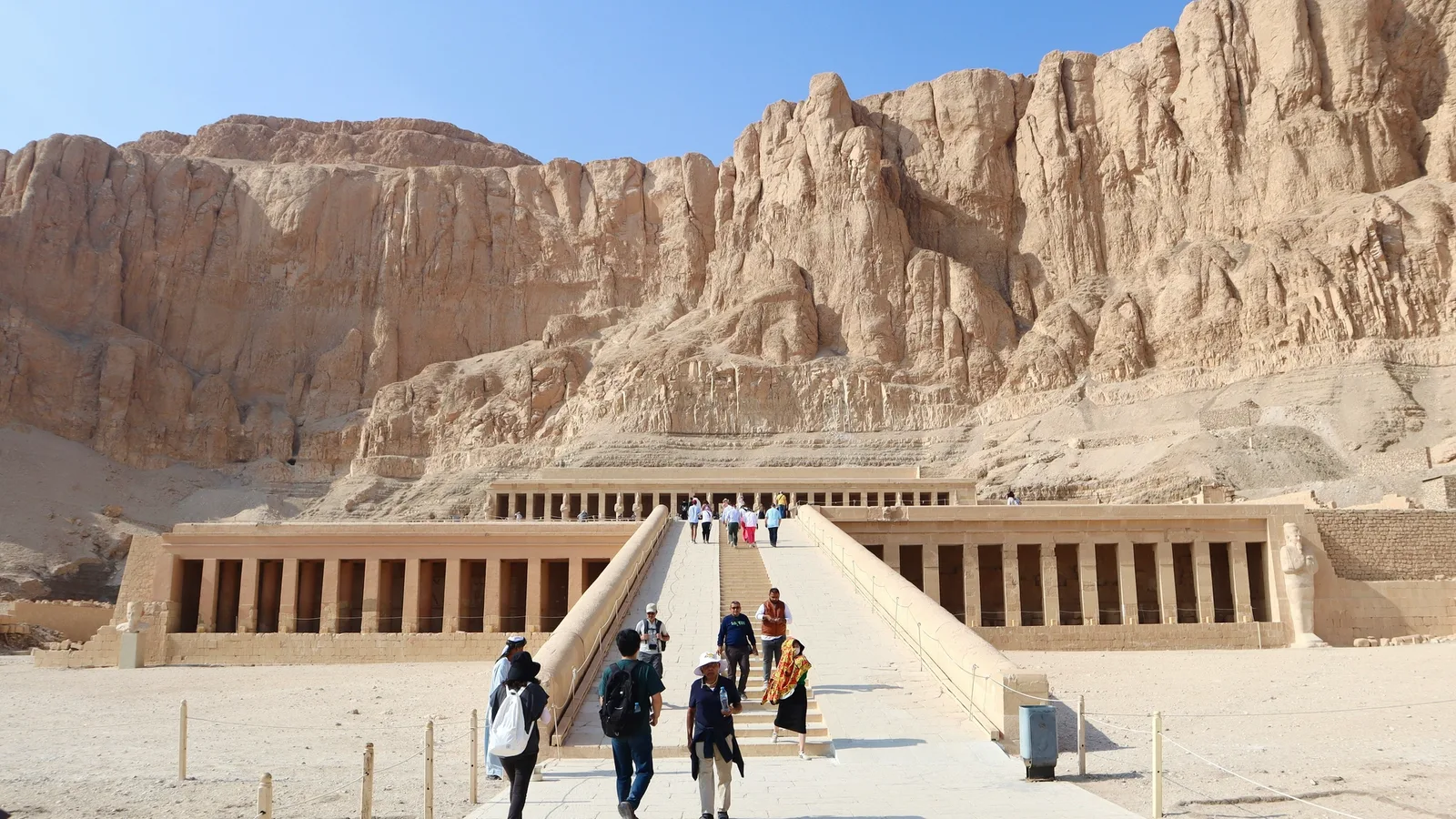
The magnificent Mortuary Temple of Hatshepsut, known in ancient times as Djeser-Djeseru ("The Holiest of Holy Places"), sits dramatically beneath the towering limestone cliffs of Deir el-Bahari.
It is one of the most beautiful temples we have ever visited.
The Woman Who Ruled as Pharaoh
Hatshepsut was one of the very few women to rule Egypt as a fully recognised pharaoh.
To strengthen her legitimacy, official statues and reliefs often portrayed her with the traditional ceremonial beard and the idealised body of a male ruler.
Her temple, designed by the brilliant architect Senenmut, was centuries ahead of its time.
Many historians believe its clean geometric design anticipated architectural principles long before the construction of the Parthenon in Athens.
Architecture in Perfect Harmony with Nature
The temple consists of three vast terraces connected by long ceremonial ramps.
Rather than dominating the landscape, the structure seems to emerge naturally from the towering cliffs behind it.
Even today, its symmetry and simplicity feel surprisingly modern.
Ancient Stories Carved in Stone
The walls of Hatshepsut's temple tell remarkable stories through beautifully preserved reliefs.
Among the most famous is the account of her expedition to the legendary Land of Punt, believed by many scholars to have been located in present-day Somalia or the Horn of Africa.
The expedition returned with:
- precious timber,
- incense,
- gold,
- exotic animals,
- and even living myrrh trees, which were later planted around the temple itself.
It's one of history's earliest recorded international trade expeditions.
The Remarkable Restoration
If you admire the temple today in its impressive condition, much of the credit belongs to Polish archaeologists and conservators.
Since 1961, the Polish Centre of Mediterranean Archaeology has led one of the most ambitious restoration projects in Egypt.
Using thousands of original stone fragments, the team painstakingly reconstructed terraces, columns, and many of the famous statues of Queen Hatshepsut.
Their work has allowed visitors from around the world to experience the temple much as it once appeared over three thousand years ago.

Discussion
Comments
No comments yet. Be the first to share your thoughts.