
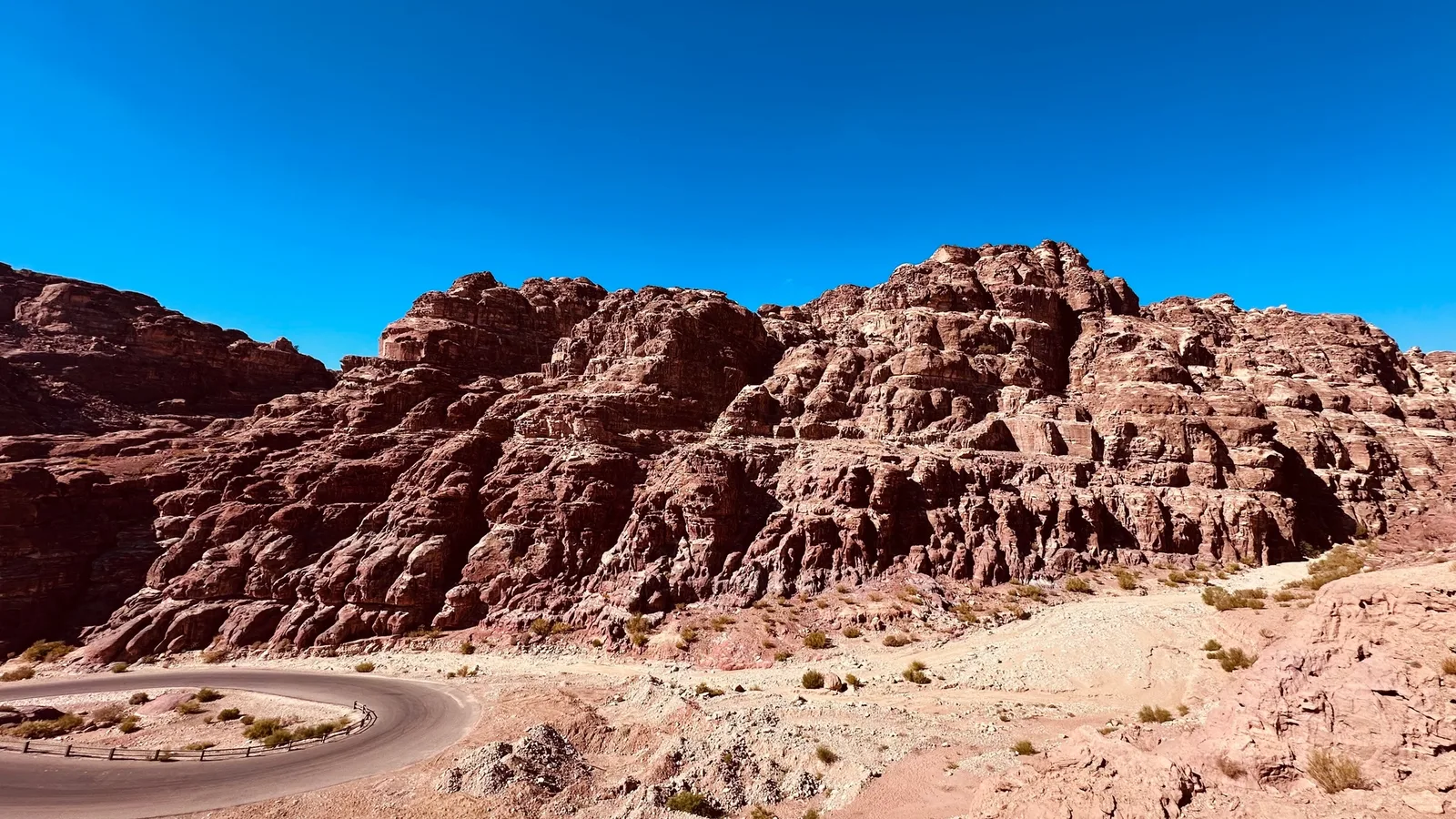
No jeeps. No donkeys. We set off for Petra’s largest monument on foot – straight from our accommodation.
800 steps, scorching sun and frustration at the amount of rubbish along the way. Our honest guide to Petra’s Backdoor Trek.
Most visitors choose the classic route through Petra.
They enter through the main gate, walk through the famous Siq, pass the Treasury and continue across the enormous archaeological site. Only towards the end of the day – when their legs are already exhausted – do they begin the long climb up to the Monastery (Ad Deir).
We decided to do things differently.
I had a 2-day Jordan Pass, which meant I could visit Petra twice and experience the ancient city from two completely different perspectives.
On our first visit, we explored Petra via the classic route.
For the second day, however, we wanted something different.
Instead of entering through the main gate and walking all the way back to the Monastery, we chose the route from the other side – the famous Petra Backdoor Trek.
And we made one more decision.
No jeep. No donkey. We would walk the entire way.
A Separate Trip to Little Petra by Car – Completely Free
Before we get into the challenging trek to the Monastery itself, there is one place we definitely need to mention – and we recommend visiting it as a separate trip.
Little Petra (Siq al-Barid) lies approximately 9 kilometres north of the main Petra archaeological site.
Although it is much smaller and far less famous than Petra itself, it is well worth visiting – especially if you have your own car and enough time to explore the area at a slower pace.
And there is another major advantage:
Visiting Little Petra is completely free.
- Getting there and parking: We drove to Little Petra by car without any problems. There is a large unpaved parking area directly by the entrance, and parking is completely free.
- Free admission: Unlike the main Petra archaeological site, there is currently no entrance fee to visit Little Petra. For now, at least.
What is Little Petra like? You can think of it as a kind of ancient suburb and caravan stop, where travelling merchants and their caravans could stay outside the main centre of Petra. Today, it offers a pleasant and relatively short walk through a narrow sandstone gorge.
A Hidden Gem: What You Should Know About Little Petra (Siq al-Barid)
We definitely recommend not skipping Little Petra. If you have enough time, consider splitting your Petra experience over two days, just as we did.
Little Petra has an incredible atmosphere of its own.
It is smaller, quieter and far more intimate than its famous neighbour. And in many ways, it can feel even more authentic than Petra itself.
Without the same crowds and constant movement of visitors, it is much easier to slow down, explore the rock-cut chambers and narrow passages, and simply take in the surroundings.
Little Petra may be smaller, but that is exactly where much of its charm lies.
Why Is It Called Siq al-Barid?
The name Siq al-Barid translates as “the Cold Canyon” – and once you walk inside, the name makes perfect sense.
The gorge is extremely narrow and surrounded by high sandstone walls, which means that very little direct sunlight reaches the canyon floor.
Even during the intense Jordanian summer heat, the passages remain surprisingly shady and cool.
After walking through the sun-baked landscape outside, stepping into Siq al-Barid can feel like entering a natural shelter from the desert heat.
An Ancient Highway Motel for Caravans
To understand the importance of Little Petra, you need to travel back roughly 2,000 years, to the time when the Nabataean kingdom was flourishing.
Petra was an incredibly wealthy trading centre, strategically located along major trade routes connecting Arabia with the Mediterranean world.
But huge trading caravans needed space – for merchants, goods and large numbers of camels.
That is where Little Petra played an important role.
You can think of it as a kind of ancient suburb, trading station and caravan stop outside the main city.
Caravans arriving in the region carried valuable goods such as frankincense, myrrh, spices, textiles and other luxury products from Arabia and lands much farther east.
Merchants and their animals could stop here, rest and conduct business before continuing their journey.
In modern terms, Little Petra was something like an ancient logistics hub combined with a roadside hotel and trading centre.
Except instead of trucks parked outside, there were camels.
And instead of warehouses and hotels, the Nabataeans carved rooms, halls and façades directly into the sandstone cliffs.
Something You Won’t See in Petra: The Painted House
Little Petra is home to one of the most historically valuable treasures in Jordan – something you will not find in Petra’s main archaeological area.
Inside one of the rock-cut chambers, reached by a short flight of steps roughly halfway through the canyon, you can see original Nabataean ceiling frescoes that have survived for almost 2,000 years.
What Is the Painted House?
Look up at the ceiling and you will see remarkably preserved Hellenistic-style paintings dating from around the 1st century AD.
The chamber is believed to have been used as a dining and social space, probably associated with wealthy Nabataeans and visiting merchants.
And its decoration gives us a fascinating glimpse into their world.
What Can You See in the Frescoes?
The paintings feature elaborate grapevines, bunches of grapes, flowers, birds and human figures, reflecting the strong influence of Hellenistic culture on Nabataean society.
Among the figures are small winged Erotes, associated with the Greek god of love, Eros.
The abundance of vines and grapes also suggests the importance of wine, feasting and social gatherings in Nabataean culture.
For centuries, however, these extraordinary paintings were obscured by layers of soot and smoke, partly caused by fires lit inside the chamber.
A major conservation project eventually revealed the colourful decoration hidden underneath.
The restoration, completed around 2010 with the involvement of specialists from the Courtauld Institute of Art in London, transformed our understanding of the site.
What had once looked like a dark, smoke-stained ceiling turned out to conceal one of the finest surviving examples of Nabataean interior painting.
So when visiting Little Petra, do not just walk through the canyon looking at the façades.
Look up.
One of its greatest treasures is hidden right above your head.
You can explore the entire site in approximately 30 to 45 minutes.
Entrance gate: You will pass a monumental façade carved into the rock that resembles the Treasury, only on a smaller scale.
Water cisterns: Along the way, notice the ingenious channels carved into the rock walls. The Nabataeans used them to collect rainwater and direct it into huge underground cisterns that supplied both people and animals.
The end by the Bedouins: The gorge gradually narrows until you reach the very end, where Bedouins sell tea. From here, steep steps lead further up into the rocks. If you climb them, you will be rewarded with a beautiful view of the surrounding barren landscape. From here, you turn around and follow the same route back to the free car park.
The next day, the journey to the Monastery awaits us. We are setting off from our hotel, Petra Magic, which is strategically located close to the back entrance to the valley.
We set off for the Monastery entirely on foot, straight from the door of our room – and returned along the same route.
It was a demanding trek under the direct sun that really tested our fitness, but the experience was absolutely worth it.
Right at the beginning of the trail, however, there is an important point – a checkpoint with park rangers. To pass through this checkpoint, you must already have a purchased and fully activated ticket to Petra (or a scanned Jordan Pass). Tickets are not sold here! The rangers will check your tickets and only then allow you to continue into the mountains.
- Bedouin offers: Right by the checkpoint, local Bedouins will approach you. They will try to convince you that the route is very long, the sun is scorching, and that they can take you to the foot of the mountains in their 4x4 jeeps. We declined and walked the entire route on foot. They also stared at us as if they could not believe we were really planning to walk all the way there.
The Endless Desert Trek and 800 Steps
The beginning of the route is a relentless walk through open landscape. You just keep walking under the scorching desert sun. There is very little shade, so a hat, sunscreen and a litre of water in your backpack are absolute necessities.
It was a truly demanding, long trek.
Gradually, the flat terrain begins to change and the trail starts climbing along the mountainside. You walk along rocky ledges with breathtaking views into the deep wadi valleys.
And then it finally comes – the famous staircase with 800 steps carved directly into the rock.
Along the entire length of these steps, Bedouins have set up makeshift stalls selling souvenirs, jewellery and scarves. They will call out to you, offer you tea or a donkey ride up the steps.
But what really made my blood boil during that exhausting climb – and had me literally fuming with anger – was their attitude towards nature. Right in front of our eyes, vendors were throwing rubbish, plastic and cans down from the rocks into this beautiful, thousands-of-years-old landscape.
The contrast between ancient beauty and modern, careless littering is simply incredibly frustrating.
But there was nothing left to do except grit our teeth, ignore it and keep climbing.
A Call for Ethical Tourism: Why You Should NEVER Ride Donkeys or Horses in Petra
I’m not some radical activist or environmentalist or anything like that, but I simply believe that we can climb those steps ourselves. You will be climbing, you will be tired and drenched in sweat, and the local Bedouins know that very well.
Every ten steps or so, they will offer to take you up on a donkey. They will tell you that the animal is used to it and that it doesn’t mind.
Please, say no and walk on your own.
Those donkeys are truly unfortunate animals. All day long, in the worst desert heat, when temperatures can climb towards 40°C, they have to carry heavy tourists up and down steep, slippery stone steps. They often have no shade, and you can see for yourself how the animals are treated.
And watch out for your own safety when climbing the steps as well. They ride the donkeys so fast that I was almost knocked over several times.
The Magnificent Reward – The Monastery (Ad-Deir)
As soon as you climb the final steps, all the anger and exhaustion disappear in an instant. From behind the massive rocks, the monumental Monastery (Ad-Deir) suddenly emerges in front of you.
The Monastery is the largest rock-cut monument in the entire archaeological park, and for many travellers it represents the absolute highlight of their trip to Jordan. In photos, the Monastery may look similar to the Treasury, but don’t be fooled – its scale is enormous.
- Dimensions: It measures an incredible 50 metres wide and almost 45 metres high. To give you an idea: the entrance doorway alone is as tall as a two-storey house, while the stone urn rising at the very top of the monument is over 9 metres high – roughly the size of a small family house.
- Style: Unlike the Treasury, which is filled with detailed Greek sculptures and delicate decorations, the Monastery has a much cleaner, more massive and austere design. The façade uses deep shadows and enormous Corinthian columns rising directly from the sandstone rock, giving it an incredibly powerful, almost raw appearance.
The Mysterious History: What Was It Actually Used For?
The true purpose of the Monastery is still surrounded by questions, which gives the place a fascinating sense of mystery.
Original Nabataean purpose (1st century BC): Archaeologists believe that the structure was dedicated to the Nabataean king Obodas I, who was declared a god after his death. Inside the building is a huge, austere chamber with a large niche known as a motab, where religious rituals, ceremonial feasts and symposiums were probably held in honour of the deceased king.
How did it get the name “Monastery”? Just like the Treasury, this is a modern name. During the Byzantine period, around the 4th to 5th centuries AD, Christianity spread throughout Petra. Christian monks took over this abandoned monumental structure in the mountains. They began using the interior as a church and carved large crosses into the sandstone walls at the back, which can still be seen today. Since then, local Bedouins have called it Ad-Deir – the Monastery.
Today, visitors are not allowed to enter the interior of the Monastery in order to protect the soft sandstone, but you can see inside very well through the massive open doorway.
Do not expect any hidden corridors or halls. Inside, there is just one enormous, perfectly carved square room.
The ceilings and walls are particularly fascinating – the sandstone in this part of the mountains has incredible yellow-brown and pink bands that look like carefully painted layers of wood or marble.
Photography tip: Just before you reach the open area in front of the Monastery (when approaching via the Backdoor Trek), there are elevated rock caves. If you climb into one of them, you can photograph the Monastery through a natural rock window.
Because we had parked our car at the Petra Magic Hotel, after visiting the Monastery and the viewpoints, we turned around and headed back along the same back route.
Going down the steps was a little easier, but the desert section under the blazing sun gave us a hard time once again on the way back.
When we finally arrived back at the hotel, exhausted, we knew that we had experienced Petra in as wild and authentic a way as possible.
At the checkpoint, they welcomed us again and could hardly believe their eyes that we had actually walked the entire route on foot. :D


Discussion
Comments
No comments yet. Be the first to share your thoughts.