
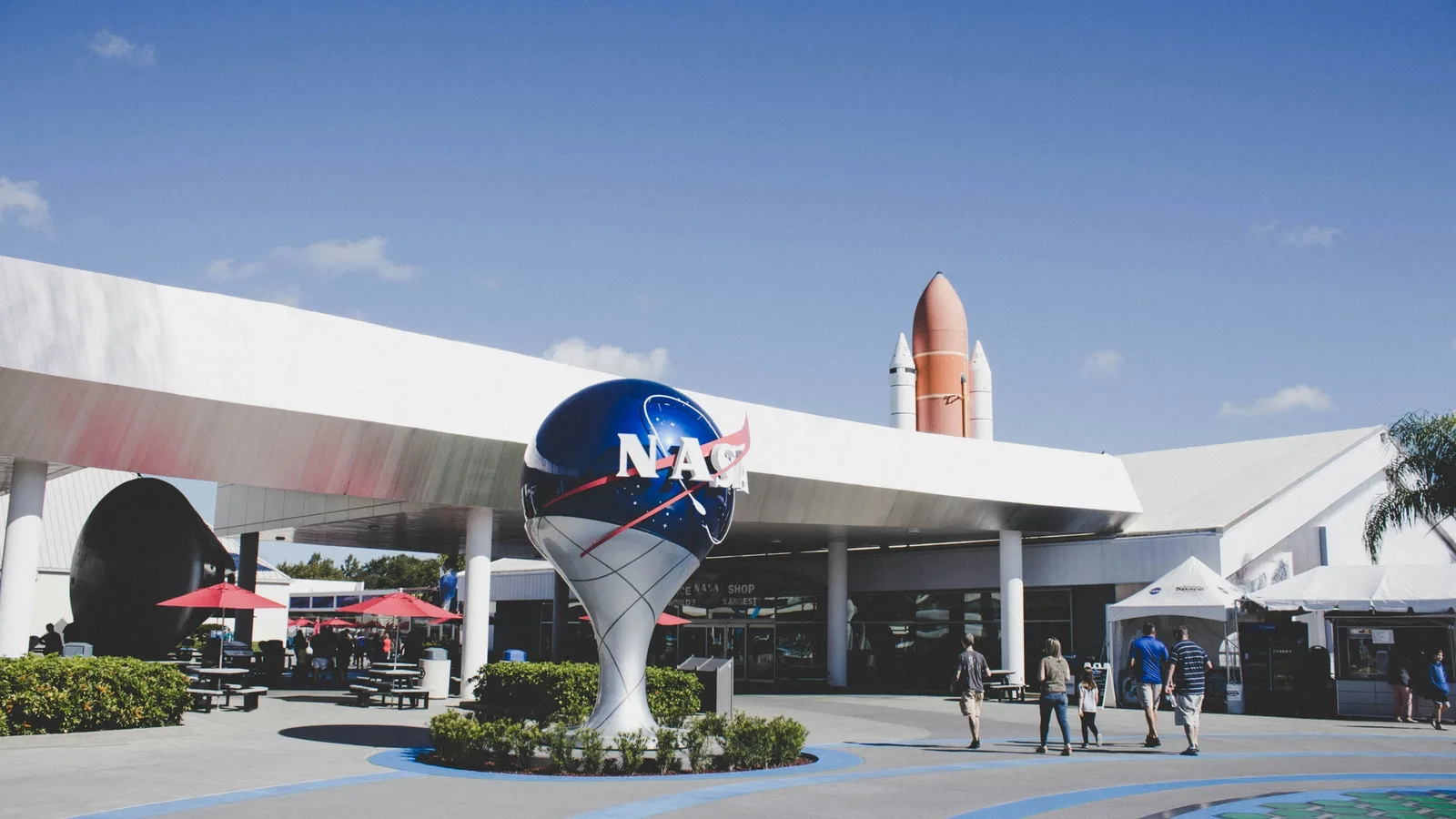





There are places that broaden your horizons, and then there are places that completely change your perspective on the world and human capability. The Kennedy Space Center (KSC) in Florida belongs firmly in the second category. This is no ordinary museum with exhibits behind glass. It is a pulsing, living monument to human courage, brilliance, and incredible national pride. It is the very place where humanity left the cradle of Earth to touch the Moon, and from where we are now launching toward Mars.If you are planning a trip to Florida, this is a destination that absolutely demands a full day of your time. Here is a complete guide, packed with both raw emotion and practical information, on how to make the most of your visit to NASA.
Visiting a place so deeply steeped in history was a true dream come true. To be completely honest, my partner and I were absolutely overwhelmed and fighting back tears... You really have to experience it for yourself to fully understand the emotion. Of course, it also depends on how big of a space enthusiast you are and how much you love everything that goes with it. The main highlight on our itinerary was supposed to be the launch of the Artemis II mission, but luck wasn't on our side, and it was scrubbed due to weather. Even though a different mission successfully launched just two days later, we were already too far away from KSC by then. We told ourselves that, if nothing else, it gives us the perfect reason to fly back to Florida. And we definitely will!
The Secrets of Its Location and Deep History: Why Here?
It all began during the Cold War. When the Soviet Union launched Sputnik in 1957, America suffered a major shock. In 1961, President John F. Kennedy delivered his famous speech, promising that America would land a man on the Moon and return him safely to Earth before the decade was out.This mammoth task required a massive new facility. The choice fell on Merritt Island, Florida—which, up until then, had been nothing but an impenetrable wilderness teeming with mosquitoes and alligators. There were three strategic reasons for this choice:
- Safety over the ocean: Rockets launch from here toward the east, out over the Atlantic. If an accident occurs, spent stages or debris fall safely into the ocean rather than on populated areas.
- The Earth’s speed boost: The island is located close to the equator. The Earth's rotation is fastest at these latitudes, giving launching rockets a natural "free boost" of speed (around 913 mph / 1,470 km/h).
- Accessibility by water: Gigantic rocket components could easily be shipped here on barges from factories all across America.
Americans are an incredibly proud nation, and KSC is tangible proof of what they can accomplish when they unite for a grand goal. That atmosphere of patriotism and pride in technological progress sweeps you off your feet the moment you walk through the gates.
Practical Information: Location, Directions, and Tickets
How to get there: It makes for an absolutely perfect day trip from Orlando. Just hop in the car and take SR 528 (Beachline Expressway), which will bring you straight to the gates in about 45 to 50 minutes. From Miami, it’s a longer drive—roughly 3.5 hours heading north along the I-95. On-site parking costs $15 per day. The night before our visit, we stayed in Port St. Lucie.
Admission and opening hours: The complex opens at 9:00 a.m. and closes at either 5:00 p.m. or 6:00 p.m. depending on the season. A one-day adult ticket costs approximately $75 (plus tax). You should definitely buy your tickets online in advance on the official Kennedy Space Center website so you don't waste time waiting in lines in the morning.
USEFUL TIP #1: Head straight for the bus first thing! Most people make a classic mistake when they enter the complex: they immediately start taking photos of the rockets near the entrance or head into the nearest pavilion. As a result, massive lines form around noon at the main attraction. Do the exact opposite. Right after passing through security, walk all the way to the back of the complex to the KSC Bus Tour boarding area. This bus tour is completely free and included in your admission ticket, taking you deep into the operational spaceport.
What you will see during the bus tour:
- The VAB (Vehicle Assembly Building): One of the largest buildings in the world by volume. It is so incredibly massive (standing 525 feet / 160 meters tall) that it has its own indoor microclimate—on hot Florida days, rain clouds can actually form right under the ceiling! The American flag painted on its side is the size of a professional football field, and the individual stripes alone are as wide as a standard highway lane.
Crawler-Transporters (Crawlers): Incredibly massive monsters the size of a baseball diamond that transport fully assembled rockets from the VAB to launch pads 39A and 39B at a blistering speed of 1 mph (1.6 km/h). These giant machines burn an unbelievable 350 gallons of diesel per mile (around 300 liters per kilometer)!
The bus drops you off at the separate Apollo/Saturn V Center. Here, you will experience a simulation of the Apollo 11 launch inside an authentic firing room, complete with original blinking monitors and green text displays. Then, the doors to the main hall swing open, and you stand face-to-face with an actual, 363-foot-long (110 meters) Saturn V rocket. It is laid out on its side, allowing you to walk right underneath its massive F-1 engines. The combined power of these five engines at launch was greater than the output of 85 Hoover Dams! By heading here first thing at 9:15 a.m., you will find the entire center half-empty and can take photos completely free of crowds.
When you get on the bus, make sure to sit on the right side—you will see a whole lot more!
Flawless Multimedia Presentations and Tears in Your Eyes at Atlantis
Americans are the absolute world champions of presentation and storytelling. Do not expect boring text panels at KSC. Every single exhibit begins as a thrilling cinematic experience in a theater with surround sound, visual effects, and historic footage that emotionally prepares you for what you are about to see.The most powerful moment of the entire day awaits you in the Space Shuttle Atlantis pavilion. The presentation charts the incredibly rocky road behind developing a reusable spacecraft. As the film reaches its climax and you are left with goosebumps all over your body, the cinema screen suddenly turns translucent, and there she is, emerging behind it in the dim light. The actual, space-weathered, scorched, and scratch-covered Atlantis space shuttle, which successfully completed 33 missions.
The screen lifts, and you can walk right up to her. At that exact moment, half the room—including us—has tears in their eyes. It is such a powerful, majestic, and deeply moving moment that you will never forget it. You see those millions of tiny details, the thermal tiles that protected her from burning up in the atmosphere, and you fully realize the incredible fragility of human life in space.
Inside the pavilion, make sure you don't miss the Shuttle Launch Experience—an incredible simulator that shakes you so violently that for a moment, you truly believe you are leaving Earth’s atmosphere and experiencing the G-force of real astronauts. It was designed in collaboration with actual astronauts, so its authenticity is verified by those who know it best.
The Present and Future: A New Era with the Artemis Mission and SpaceX
KSC is not just about the past. In the newest, ultra-modern pavilion, Gateway: The Deep Space Launch Complex, you will see exactly what is happening right now. The space program is experiencing an incredible renaissance. On display are actual, flight-proven modules from the SpaceX Dragon and Boeing Starliner spacecraft, as well as components from the heavy-lift Falcon Heavy rocket.However, the main star of the modern era is the Artemis program, whose ambitious goal is to land humans back on the Moon and establish a permanent base there as a stepping stone to Mars.
Where to Watch Rocket Launches Live?
Thanks to SpaceX's Falcon 9 rockets and new launch systems, liftoffs from nearby pads happen almost continuously these days. If your travel dates align with a launch window, watching a rocket lift off is a once-in-a-lifetime experience. You can pay extra for a special spectator ticket package directly inside the KSC complex, but if they are sold out, you can get an excellent view of the launch from surrounding free spots as well:
- Space View Park in the town of Titusville: Located right across the river, directly opposite the launch pads. They even have loudspeakers broadcasting live commentary from NASA's mission control.
- Cocoa Beach Pier or beaches along Cape Canaveral: A beautiful view with a drink in your hand and your toes in the sand.
Where to Track Scheduled Rocket Launches
Planning your visit to KSC or the surrounding beaches to line up exactly with the day and hour of a rocket launch can be a bit of a guessing game due to frequent scrubs caused by weather or technical issues. However, with these tools, you will always have the most up-to-date information right in your pocket:
- Space Launch Schedule: Absolutely the best and most organized launch calendar in the world. You can filter specifically for Cape Canaveral / Kennedy Space Center. It displays an exact countdown, rocket type, payload, and, most importantly, the probability of favorable weather.
- Next Spaceflight: A highly detailed database for true space enthusiasts. Here, you will find individual rocket profiles, launch pad maps, and previous mission histories.
- Official Kennedy Space Center Calendar: If you want to watch a launch directly from the NASA visitor complex (and potentially purchase special grandstand tickets), their official website provides an overview of missions that coincide with the center's operating hours.
Where to Watch Launches LIVE (Online Broadcasts with Commentary)If you are not in Florida right now, or if the launch pad is simply too far away, you can watch breathtaking live streams with professional commentary:
- SpaceX (X / Twitter & YouTube): Elon Musk's company broadcasts every single launch (Falcon 9, Falcon Heavy, and Starship) live. Their streams feature incredible production quality, with cameras mounted directly on the rocket and on the drone ships out at sea. Note: SpaceX live streams have recently moved primarily to the social media platform X (formerly Twitter).
- NASA Live: NASA’s official TV channel broadcasts key scientific missions, launches to the International Space Station (ISS), and especially all the action surrounding the Artemis program. The stream runs 24/7 on platforms like YouTube.
- Spaceflight Now (YouTube): An independent news channel that sets up high-resolution cameras directly around the spaceport. They stream almost every Florida launch live, often accompanied by expert technical commentary.
A Souvenir with Style: My Artemis Mission Jacket!
You can’t wrap up your visit anywhere else than in the massive Space Shop, which is the largest space souvenir store in the world. Forget about tacky keychains. This place has items that carry a real story.
Personally, I walked away with an absolutely amazing, stylish, and functional jacket from the Artemis mission collection. It is exactly the kind of apparel featuring official NASA and Artemis program patches worn by the actual astronauts, engineers, and scientists in mission control. Every single time I put it on, I remember that incredible feeling I had at the Kennedy Space Center. A feeling that no destination is too distant for humanity.How long should you stay at KSC? I will admit it flat out: arrive at nine in the morning and don't leave until closing time. Your feet will be tired and your head will be spinning with information, but you will carry an experience in your heart that will stay with you forever.






Discussion
Comments
No comments yet. Be the first to share your thoughts.