
You know the situation. You are flying to your dream destination — Vietnam, Thailand or somewhere else in Asia — and your ticket shows a few hours of waiting at Singapore Changi Airport.
So what do you do with all that time?
Sitting around at the terminal almost feels like a waste. Although, to be fair, Changi Airport itself is fascinating and if you do not feel like heading into the city, there is plenty to discover without even leaving the airport.
But if you have enough time, leave the airport
Singapore could easily fill an entire week-long holiday.
But if you have five hours or more between flights, you can already get a surprisingly good taste of its futuristic architecture, tropical atmosphere and incredible food.
This is our tried-and-tested guide to legally “escaping” from Changi Airport and experiencing a quick Singapore adventure without unnecessary stress.
One important thing that can slow you down: SG Arrival Card
Before you even leave the aircraft, there is one thing worth sorting out.
Czech citizens do not normally need a tourist visa for a short visit to Singapore, but if you plan to enter Singapore during your layover, you need to complete the electronic SG Arrival Card.
Do it in advance
The form can be completed online up to three days before your arrival and it is free.
We strongly recommend doing this before your trip rather than leaving it until you land.
Why you should not forget it
We had the SG Arrival Card completed beforehand, which meant immigration was extremely quick and we could use the automated gates.
If you arrive without completing it, you may have to stop and fill it in on your phone or at one of the airport kiosks.
That is not a major problem if you are staying in Singapore for several days.
But during a short layover, every unnecessary ten or fifteen minutes matters.
When you only have a few hours between flights, preparing the SG Arrival Card before landing is one of the easiest ways to save valuable time.
From the airport to the city by MRT — no cash needed
Forget expensive taxis.
Singapore’s MRT is everything you would expect from public transport in one of the world’s most modern cities: clean, efficient, fully air-conditioned and extremely easy to use.
Some trains even operate automatically without drivers.
How to pay
You do not need to exchange money into Singapore dollars or buy a separate ticket.
Simply tap your regular contactless bank card, phone or smartwatch at the fare gate when entering the MRT — and tap again when leaving.
That is it.
No ticket machines. No searching for coins. No complicated fare system.
Where to change trains
From Changi Airport, take the MRT towards the city.
At Tanah Merah station, change to an East West Line train heading towards central Singapore.
The transfer is simple and well signposted.
Where to get off
For one of the best first impressions of Singapore, we recommend getting off at either Raffles Place or Downtown.
From there, you step straight into the heart of Singapore’s futuristic financial district, surrounded by skyscrapers and within walking distance of many of the city’s most famous sights.
The journey from Changi Airport to central Singapore usually takes around 30–40 minutes.
And within less than an hour of leaving your aircraft, you can go from an airport terminal to standing beneath Singapore’s skyline.
Half-Day Singapore Itinerary: What Can You See?
The moment you step out of the air-conditioned MRT and into Singapore’s hot, tropical air, the skyline hits you immediately.
And the good news is that once you reach the centre, many of the city’s biggest highlights can be explored on foot within just a few hours.
Marina Bay and the Merlion
From Raffles Place station, walk towards the waterfront and the famous Merlion — Singapore’s iconic half-lion, half-fish statue spraying water into Marina Bay.
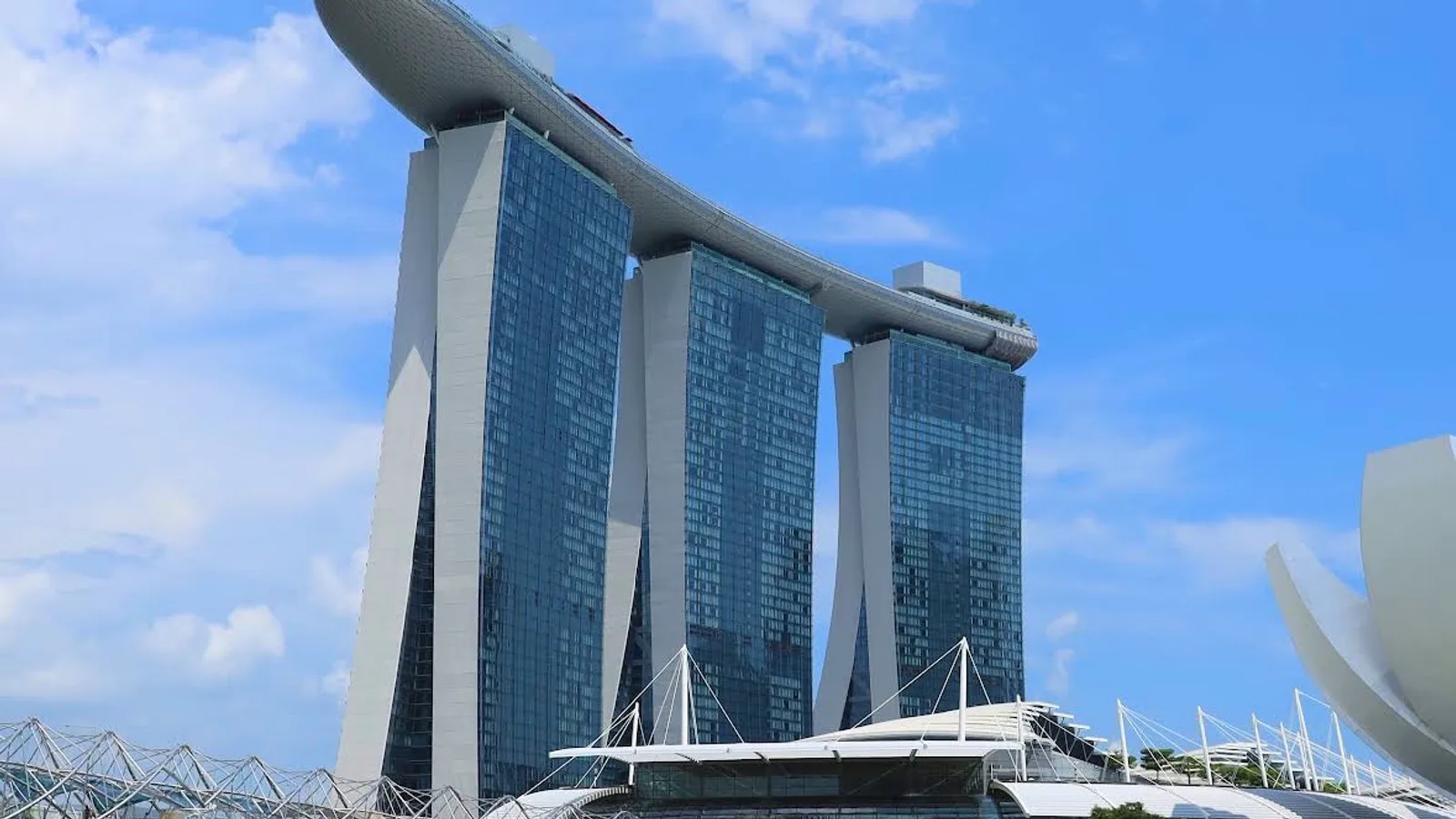
From here, you also get one of the classic views of Marina Bay Sands, the unmistakable hotel with its enormous ship-shaped rooftop.
It is probably the moment when you first think:
Yes, this is Singapore.
Walk around Marina Bay
Continue along the waterfront and enjoy the contrast between tropical greenery, glass skyscrapers and futuristic architecture.
Cross the ultra-modern Helix Bridge, one of the most distinctive pedestrian bridges in the city.
The walk itself is part of the experience. You are constantly surrounded by views that make Singapore feel like a city from the future.
Gardens by the Bay
From Marina Bay, continue towards Gardens by the Bay, one of Singapore’s most famous attractions.
The highlight is the incredible Supertree Grove — giant artificial tree-like structures covered in plants that have become one of the symbols of modern Singapore.
If your layover happens to be in the evening, try not to miss Garden Rhapsody, the spectacular light and music show among the Supertrees.
The show is free and currently takes place every evening at 7:45 PM and 8:45 PM.
Standing beneath the illuminated Supertrees with the Singapore skyline behind them is one of those experiences that makes you forget that, technically, you are only here because of a flight connection.
🍜 Food experience: Dinner at Lau Pa Sat
Singapore may be an expensive city, but that does not necessarily apply to food, thanks to its famous hawker centres — covered food halls filled with dozens of stalls serving dishes from across Asia.
We headed to the historic Lau Pa Sat, right in the heart of Singapore’s financial district.
Satay Street
Every evening, the street next to Lau Pa Sat is closed to traffic, tables are set up outside and hundreds of satay skewers begin sizzling over open grills.
Chicken, beef, prawns — all served with a rich peanut sauce.
The air fills with smoke from the grills while you sit at a simple table surrounded by the illuminated skyscrapers of what feels like the Manhattan of Southeast Asia.
For us, this was one of the best moments of our short visit to Singapore.
If your layover gives you a taste for the city and you decide to stay for a few days next time, look for affordable accommodation in capsule hostels around Chinatown, or in areas such as Geylang and Little India, where prices tend to be more reasonable.
We definitely want to return to Singapore one day and spend at least a few full days here.
A few more interesting facts about Singapore
Marina Bay Sands: the hotel you simply cannot miss
There is probably no building in Singapore that catches your eye faster than Marina Bay Sands.
Three enormous towers connected at the top by what looks like a giant ship have become one of the most recognisable symbols of the city.
But the building is even more fascinating than it first appears.
Designed with feng shui in mind
The design of Marina Bay Sands was reportedly developed with feng shui principles in mind.
The three towers are associated with prosperity, while the enormous rooftop structure appears almost as though it is catching good fortune arriving from the sea.
The famous infinity pool
At the top of Marina Bay Sands is its legendary rooftop infinity pool.
At around 150 metres long, it is one of the most spectacular elevated swimming pools in the world.
From the edge, the water appears to disappear straight into the Singapore skyline, although in reality it flows into a collection system below.
Unfortunately, there is one catch:
the pool is reserved exclusively for hotel guests.
So if swimming above Singapore is on your bucket list, you will need to book a night at Marina Bay Sands.
A viewpoint for everyone else
You do not have to stay at the hotel to enjoy the view.
Visitors can buy a ticket for the Sands SkyPark Observation Deck, located high above the city on the famous rooftop structure.
From here, you get spectacular views over Marina Bay, Gardens by the Bay and the Singapore skyline.
Gardens by the Bay: where technology meets nature
These futuristic gardens are much more than just a beautiful park.
They are also a huge experiment in combining architecture, technology and nature.
The Supertrees
The famous Supertrees are giant metal structures covered with thousands of plants.
Some reach heights of around 50 metres.
They are not there purely for decoration either. Some of the structures are integrated into the gardens’ environmental systems, helping to collect solar energy and supporting other sustainability functions.
After dark, they become the stars of the famous Garden Rhapsody light show.
The cooled conservatories
The enormous Flower Dome and Cloud Forest offer something particularly valuable in Singapore:
cool air.
Inside, temperatures are kept significantly lower than outside, creating environments suitable for plants from very different climates.
After walking through tropical Singapore in more than 30°C heat and extreme humidity, stepping inside feels almost like entering another country.
Cloud Forest is especially impressive.
Inside, you will find a huge indoor waterfall surrounded by mist and tropical vegetation.
It is one of those places that feels almost unreal.
The lion that is actually half fish: the Merlion
When you stop for the classic photo with Singapore’s famous water-spouting Merlion, there is a little more behind the statue than you might expect.
It combines two important symbols.
The lion’s head refers to the name Singapura, traditionally translated from Sanskrit as “Lion City.”
The fish body represents Singapore’s maritime origins and its historic identity as Temasek, a settlement closely connected with the sea.
Today, the Merlion is one of the most recognisable symbols of Singapore.
What not to miss if you have more time: 2–3 days in Singapore
If you are lucky enough to stay longer than a layover, there is much more to explore.
Chinatown and Buddha Tooth Relic Temple
Chinatown is one of the easiest places to experience a completely different side of Singapore.
Its streets are filled with lanterns, temples, small shops and food.
One of the highlights is the beautiful Buddha Tooth Relic Temple, a striking multi-storey Chinese Buddhist temple said to house a relic believed to be a tooth of the Buddha.
Even if temples are not usually your main reason for travelling, the building itself is worth seeing.
Kampong Glam
Then there is Kampong Glam, Singapore’s historic Muslim quarter.
Its most recognisable landmark is the beautiful Sultan Mosque, with its enormous golden dome.
Just a short walk away is Haji Lane — a narrow street filled with colourful murals, cafés, boutiques and small design shops.
The atmosphere here feels completely different from the glass skyscrapers around Marina Bay.
Night Safari
Singapore is also home to the famous Night Safari, one of the world’s best-known wildlife attractions focused specifically on nocturnal animals.
Instead of visiting during the day, you explore after dark, when many of the animals are naturally more active.
A tram takes visitors through different habitat zones, and there are also walking trails.
If you are travelling with children — or simply love wildlife — this can easily fill an entire evening.
Architectural madness: the floating Apple Store
Even if you are not an Apple fan, this building is almost impossible to ignore while walking around Marina Bay.
Apple Marina Bay Sands sits directly on the water inside a huge glass sphere.
From a distance, it looks like a futuristic bubble or even a small spaceship floating in the bay.
The structure is made from more than a hundred specially designed glass panels.
You can enter through a tunnel from the nearby shopping centre or via the waterfront entrance.
The interior was inspired in part by classical domed architecture, with a circular opening at the top allowing natural light to enter.
There are even real trees inside.
And thanks to the glass exterior, you get panoramic views of the surrounding skyline.
At night, when the sphere lights up against Marina Bay, it becomes one of the most futuristic-looking buildings in the city.
A few bizarre Singapore facts to finish
Chewing gum restrictions
Singapore is famous for its strict rules, and chewing gum is probably the best-known example.
The sale and import of ordinary chewing gum were heavily restricted in the early 1990s.
One of the reasons often mentioned is that discarded gum was causing maintenance problems in public spaces, including the MRT system.
Singapore certainly takes cleanliness seriously.
Owning a car is an extreme luxury
Buying a car in Singapore is nothing like buying one in Europe.
Before you can even own a vehicle, you generally need a Certificate of Entitlement — COE.
These certificates can cost an enormous amount of money and normally give you the right to own and use the vehicle for a limited period, typically ten years.
And that is before you even pay for the car itself.
It is one of the reasons why Singapore invests so heavily in public transport — and why the MRT is such an important part of everyday life.
The other side of Singapore
Singapore can initially feel almost perfect.
Everything is clean.
Everything works.
The streets feel safe, public transport is excellent and the city seems unbelievably organised.
But the longer you stay, the more you may notice things that some European travellers could find slightly uncomfortable.
Sterility and a lack of chaos
Everything is so carefully planned, clean and controlled that parts of the city can sometimes feel almost too perfect.
A little artificial.
A little cold.
Especially if Singapore is your first stop before travelling further into Southeast Asia, the contrast can be enormous.
Arrive in Vietnam afterwards and suddenly there are scooters everywhere, street stalls spilling onto pavements, people shouting, horns sounding and life happening in every direction.
Singapore is almost the exact opposite.
Whether that is a positive or a negative depends entirely on what you enjoy.
Living between tropical heat and freezing air conditioning
Singapore loves air conditioning.
Outside, you can have temperatures above 30°C combined with extremely high humidity.
Then you step into the MRT, a shopping mall or a shop and suddenly it feels freezing.
The temperature difference can be brutal.
The first time I walked into a shop just to buy a drink, the blast of cold air was so strong that I felt as though I had completely frozen on the spot.
A light layer in your backpack is not a bad idea, especially if you are spending a lot of time indoors.
A city built around performance
Singapore is extremely successful, efficient and competitive.
But that level of efficiency also comes with pressure.
During rush hour, especially in the evening, you may notice tired faces on the MRT and a very fast-paced working culture.
It is an interesting contrast to the relaxed image many people associate with tropical Southeast Asia.
Rules, rules and more rules
Singapore’s feeling of safety and order comes with a long list of regulations.
There are cameras across public spaces and rules are taken seriously.
Eating and drinking are prohibited on the MRT, for example, and breaking transport regulations can lead to substantial fines.
For some visitors, this level of control feels reassuring.
For others, it can feel restrictive.
But there is no denying one thing:
the system works.
So, would Singapore tempt you?
For us, a few hours were enough to realise that Singapore deserves more than just a quick layover.
We came expecting a futuristic city, skyscrapers and an impressive airport.
We left remembering satay smoke beneath illuminated towers, tropical humidity, freezing metro carriages, spotless streets and a city that seems to operate with almost impossible precision.
Next time, we want to stay longer.
Because Singapore may be small on the map, but there is far more to discover here than you can possibly squeeze into eight hours.

Discussion
Comments
No comments yet. Be the first to share your thoughts.