
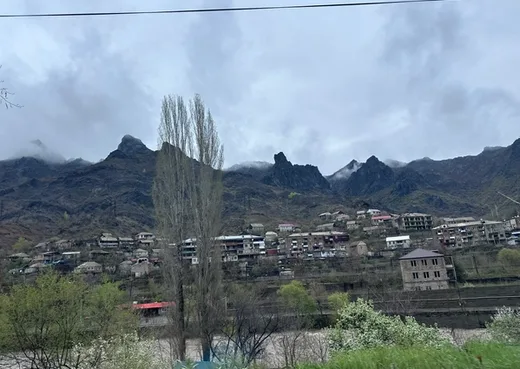
I have noticed that I mention returning to almost every country in the introduction to each article. I have no idea how I am supposed to manage all of these return trips, but so be it.
Yerevan: A Pink City Full of Contrasts
Yerevan is a city that embraces you with its warmth.
It is one of the oldest cities in the world, yet it feels incredibly youthful. Most of its buildings are made from pink tuff, a volcanic stone that gives the city a magical colour at sunset.
We arrived at the airport at a rather unfriendly hour – two in the morning.
By the time we found the accommodation near the airport that I had booked in advance, it was almost half past four.
I have no idea where we had ended up, but the road leading to our accommodation looked like a military training ground. Holes, potholes and even more potholes.
God help us. 😀
Fortunately, after a short conversation, the owner waited for us and successfully guided us to our little room.
Then again, what could I expect for CZK 130 per person per night?
We sacrificed a few hours to sleep, and in the morning, we drove to the nearest metro station because we preferred to use public transport to reach the city centre.
Since we were unable to buy either a token or a metro card, a helpful security guard simply allowed us to travel for free.
Our first impression of Yerevan was rather mixed.
Brutalist architecture was everywhere.
What We Visited in Yerevan
The Cascade
The Cascade is a monumental staircase that also serves as an open-air gallery.
Once you reach the top, the whole of Yerevan lies beneath you, with the majestic Mount Ararat rising in the distance.
It is a place where locals gather in the evening to drink wine and enjoy life.
Designed by architect Jim Torosyan in the 1970s, the structure is essentially a gigantic limestone staircase divided by terraces filled with greenery, fountains and imaginative sculptures.
Republic Square
Republic Square is the heart of the city and is famous for its singing fountains.
Here, Soviet architecture feels grand rather than oppressive.
Armenian Coffee and Local Flavours
Yerevan smells of strong Armenian coffee prepared in a jazve, the traditional coffee pot.
Street sellers offer dried fruit stuffed with nuts, known as sujuk, as well as fresh lavash bread.
A glass of pomegranate juice is also rather refreshing in the intense heat.
Brutalism Everywhere You Look
For lunch, we wanted to try something local.
Tea and lahmajun turned out to be exactly what we needed.
We climbed all the way to the top of the Cascade and had the whole of Yerevan spread out beneath us.
A short distance from the top stands the enormous Mother Armenia statue.
Naturally, it overlooks what looks like a small amusement park.
A touch of nostalgia.
It has its own peculiar charm.
Jermuk mineral water, however, became our constant companion from the beginning of the journey until the very end.
Garni and the Symphony of Stones
Garni and the nearby gorge containing the Symphony of Stones are two completely different worlds located only a few hundred metres apart.
It is a place where the ancient world meets an almost incomprehensible creation of nature.
Garni: Ancient Greece in the Middle of Armenia
The Temple of Garni looks almost unreal in the Armenian landscape.
While the entire country is filled with austere stone Christian monasteries, Garni is the only surviving pagan temple in Armenia and the former Soviet Union.
It was built in the first century AD and dedicated to Mihr, the god of the sun.
It survived because Armenian kings loved using it as their summer residence and did not want to destroy it after the country adopted Christianity.
A powerful earthquake reduced it to ruins in 1679, but during the 1970s, Soviet archaeologists literally reconstructed it stone by stone.
The Symphony of Stones
When you descend from the plateau near the temple into Garni Gorge – along another road filled with holes and loose stones, as is traditional in Armenia – you suddenly find yourself standing in front of something resembling a gigantic organ carved into the cliffs.
This is the Symphony of Stones.
These monumental basalt columns were formed millions of years ago as lava slowly cooled.
They are remarkably straight. Some are around half a metre wide and rise several dozen metres above the ground.
Why Is It Called a Symphony?
When you stand directly below the columns and look upwards, it feels as though the stone pipes could begin playing at any moment.
They are packed so tightly together that they appear to have been carved by hand, yet they are entirely the work of nature.
The Experience
You can walk directly up to the cliffs and touch the columns.
You will also often see fallen sections that have broken under their own weight, which only adds to the raw character of the place.
The Azat River flows through the bottom of the gorge.
The air is pleasantly cool, and the atmosphere is completely different from the busy temple above, where crowds of tourists arrive throughout the day.
When visiting Garni, combine it with a trip to Geghard Monastery, which is located only a few kilometres away.
Part of the monastery is carved directly into the rock, and its atmosphere perfectly complements the ancient Temple of Garni.
On the morning of our second day, we left Yerevan and headed towards the Temple of Garni.
Lake Sevan: A Sea in the Clouds
Sevan is not just an ordinary lake. It is one of the highest large freshwater lakes in the world, lying at an altitude of approximately 1,900 metres above sea level.
Watching the surface of the lake is incredible. Within a single hour, its colour can change from bright azure blue to deep turquoise and then to steel grey, depending on how the clouds move across the sky.
During the Soviet era, the water level of Lake Sevan was drastically reduced for irrigation and hydroelectric power production. It dropped by almost 20 metres.
As a result, the island on which the monastery originally stood became the peninsula we see today. When you look at old photographs, you can clearly see that the monastery once appeared to float in the middle of the lake.
Sevanavank Monastery: The Black Guardian
Sevanavank Monastery was founded in 874 by Princess Mariam. Its appearance is typical of Armenian religious architecture: austere, monumental and built from dark volcanic stone. It was also extremely windy on the day of our visit. More than 200 steps lead from the car park to the monastery. The climb is worth the effort because with every step, the panorama becomes wider, revealing the lake surrounded by the snow-covered peaks of the Lesser Caucasus Mountains.
The complex contains two main churches: Surb Arakelots, the Church of the Holy Apostles, and Surb Astvatsatsin, the Church of the Holy Mother of God.
Do not expect gold decorations or elaborate Baroque interiors. These are raw stone spaces where the only decorations are candles and ancient khachkars, traditional Armenian stone crosses.
The Khachkars
Some of the most beautiful khachkars in the country can be found at Sevanavank. They are carved from green andesite, which is quite rare, and their intricate details resemble delicate lace.
What Not to Miss at Lake Sevan
Sevan Trout – Ishkhan
This fish is legendary in Armenia. Restaurants around the lake usually prepare it grilled or steamed with herbs. Its flavour belongs to Sevan just as much as the monastery itself.
Windy Weather
Even when the temperature in Yerevan reaches 30 degrees and the heat is almost unbearable, a sharp, icy wind can blow beside Lake Sevan. It is the kind of place where shorts and a T-shirt are quickly replaced by a sweatshirt. Sevanavank feels especially spiritual early in the morning, before the tourist buses arrive from Yerevan. The silence, broken only by the sound of the lake far below, is almost impossible to describe.
On the Way to Our Accommodation
Along the way, we came across a very inexpensive roadside restaurant where we enjoyed an excellent meal.
Baklava – I can never resist it.
Older generations may remember Aljonka chocolate.
Dilijan: The Armenian Switzerland
All you need to do is drive through a tunnel, and the entire landscape suddenly changes. The dry mountains disappear and are replaced by deep green forests.
Dilijan was a rather unusual town. One thing that caught my attention was that wherever we travelled – through towns, villages or along the road – there seemed to be coffee vending machines everywhere. I have no idea why, but I found it strangely amusing. Dilijan is all about peace and quiet.
Its old quarter, with traditional wooden balconies, transports you back to the 19th century. The town is associated with artists and craftspeople and feels like an oasis where time has stopped. We stayed in one of our best local accommodations here.
The homemade breakfast served by our hosts was nothing short of magnificent. The table was covered with hard-boiled eggs, fresh lavash, cakes, cold cuts, cheese, yoghurt, pancakes filled with meat, homemade jams, pastries and oatmeal with fruit. It was a genuine feast.
Alaverdi: An Industrial Town Made for Urban Exploration
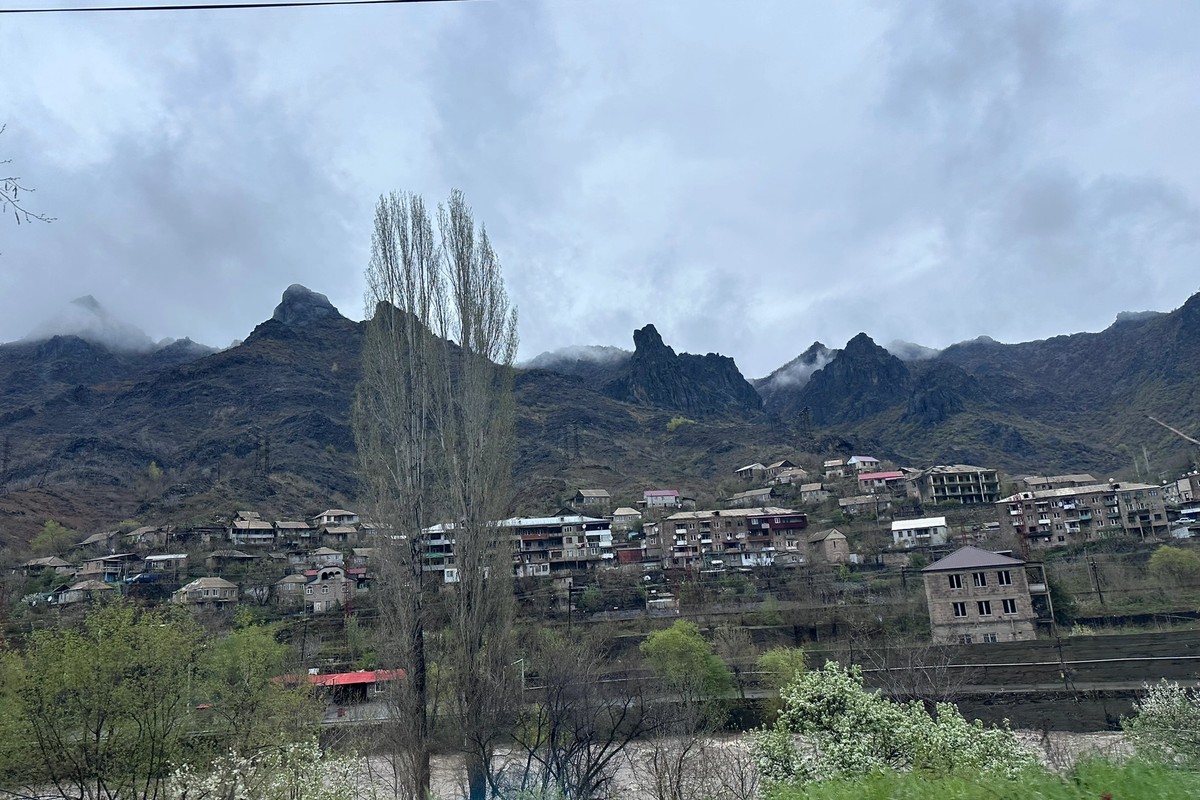
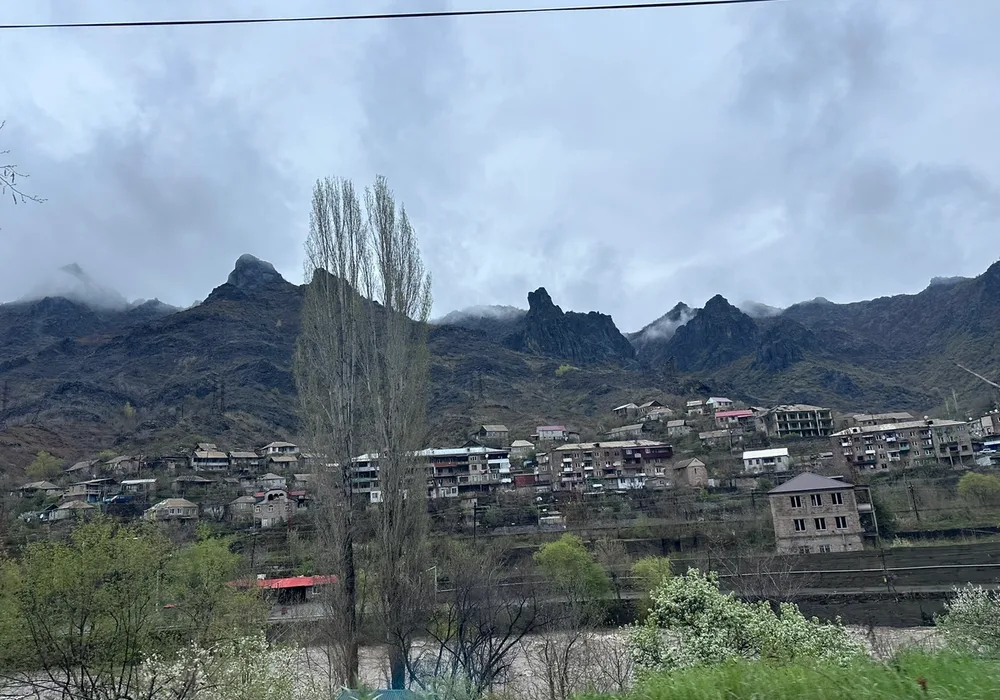
Our journey then continued towards Alaverdi. This former industrial town is an ideal destination for anyone interested in urban exploration. A short distance from the town, we stayed in what was definitely one of our best accommodations in Armenia.
The views were beautiful, and once again, we were served a generous dinner and breakfast. The property was located directly above Haghpat Monastery.
Alaverdi.
Urban exploration.
An abandoned cable car.
The closed cable-car station.
The entire building and its surroundings were deserted.
The wild river running through Alaverdi.
Haghpat: The Spiritual Highlight of the Journey
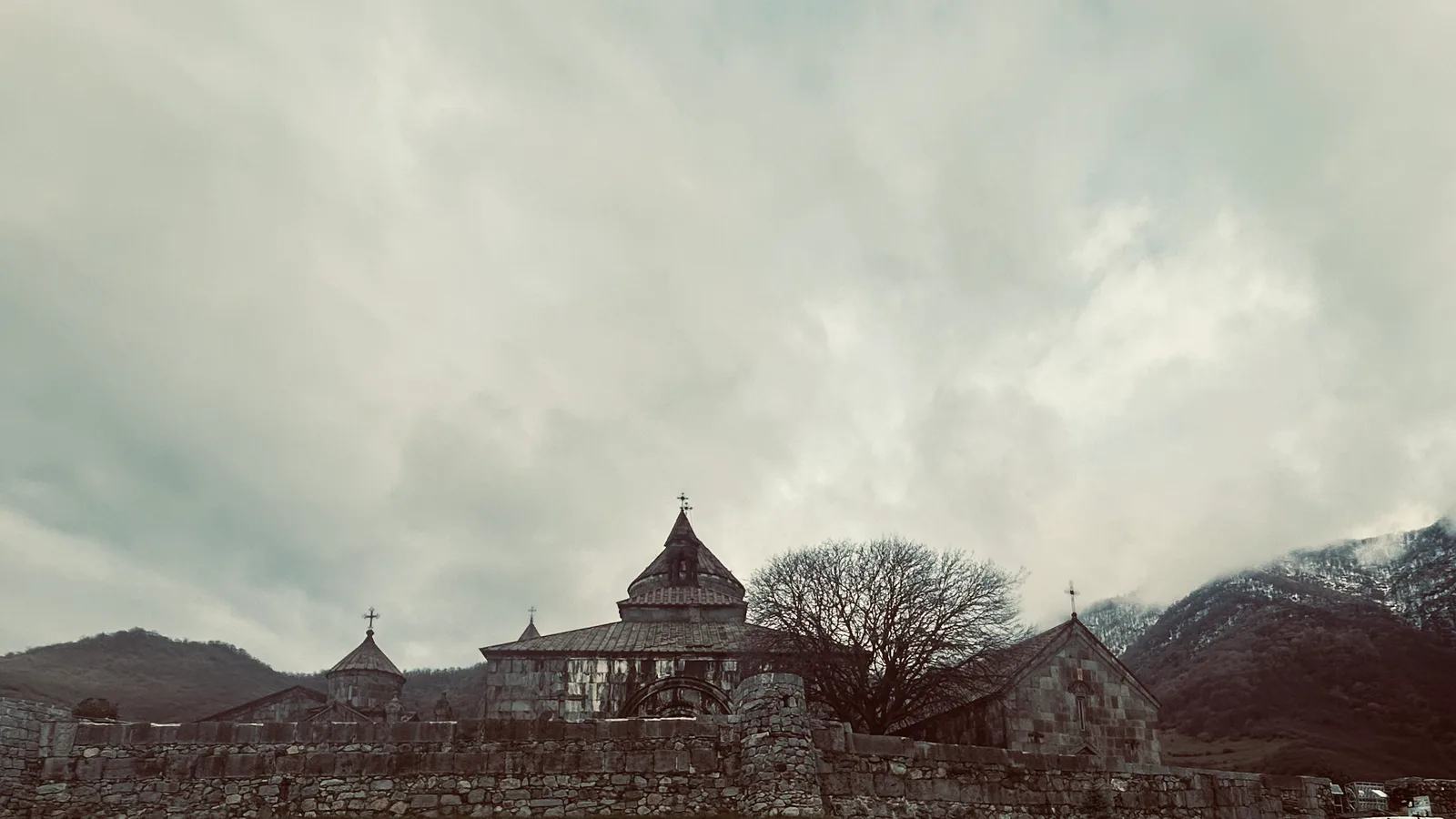
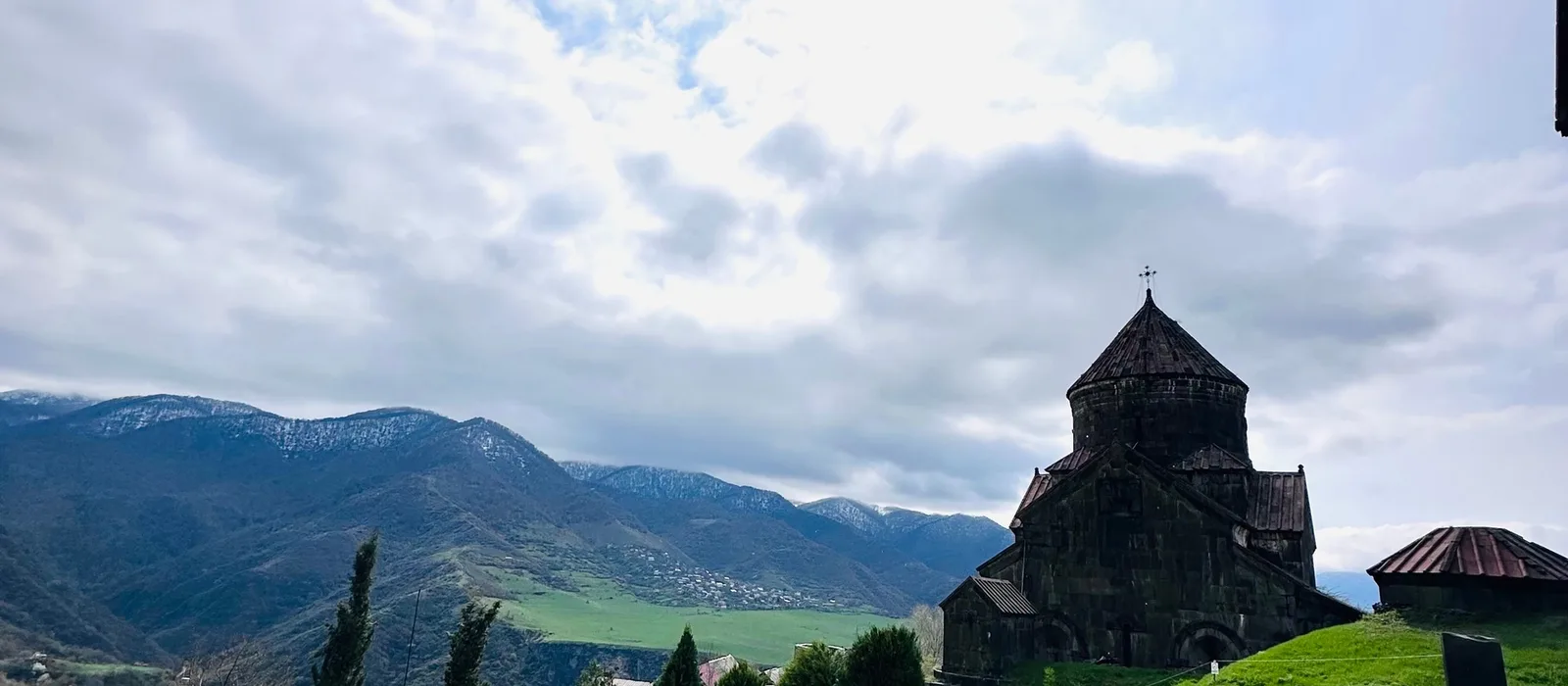
High above Alaverdi, where the roads become even worse, lies Haghpat Monastery. It is a masterpiece. Inside, the atmosphere is dim, damp and silent. The only sounds are dripping water and the occasional whisper of a prayer. Stone crosses carved with incredible precision are scattered throughout the complex. This is where you begin to understand why Armenians are so proud of their faith. These buildings look as though they will remain standing for another thousand years, regardless of what happens in the valley below.
Haghpat.
The view from our accommodation.
Homemade jam.
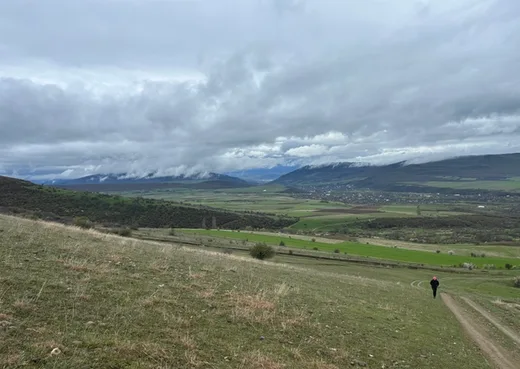
Travelling through Armenia.
A short stop to stretch our legs.
Armenia is not about perfect roads. It is about knowing that after every pothole, another breathtaking view or unforgettable homemade breakfast may be waiting for you.
Where to Stay
1. Mon Invite Hotel
You would never expect to find such a pleasant hotel with breakfast in this particular neighbourhood.
Price: CZK 945 per night for two people
Booking: https://www.booking.com/Share-lVPqIx0
2. Verin Tun
Excellent accommodation near Lake Sevan in the town of Dilijan.
Breakfast was included, and the property offered beautiful mountain views.
Price: CZK 1,150 per night
Booking: https://www.booking.com/Share-RknFuR
3. Colibri Hotel
In my opinion, this was the best accommodation we had in Armenia.
I booked it almost at the last minute, and the hosts still prepared both dinner and breakfast for us.
We were extremely satisfied.
Price: CZK 1,200 per night
Booking: https://www.booking.com/Share-4Pb2DBb
4. Vertoni Hotel Yerevan
Our final accommodation before the flight home.
Breakfast was included, and we had a view of the Mother Armenia monument.
Price: CZK 800 per night
Booking: https://www.booking.com/Share-PcykQVy


Discussion
Comments
No comments yet. Be the first to share your thoughts.