
A Long Weekend in the Bulgarian Mountains That Will Take Your Breath Away
When people in the Czech Republic hear the word Bulgaria, many still picture socialist-era nostalgia, cheap beer and rows of umbrellas on the beaches of Golden Sands.
But that is a huge mistake — and probably one of the biggest marketing crimes against this country.
Because Bulgaria’s greatest treasure is not hidden by the sea.
It is high in the mountains, where sharp granite peaks rise into the sky, glacial lakes reflect the surrounding landscape and the air feels like pure freedom.
I have a soft spot for the High Tatras, and in some places the Rila Mountains reminded me of them. Rila is the highest mountain range on the entire Balkan Peninsula, with Musala reaching 2,925 metres above sea level, and that made the experience even better for me.
If you love the raw beauty of the High Tatras but are tired of endless crowds on the most popular trails, the rugged Bulgarian mountains may be exactly what you are looking for.
Come with us on an intense long weekend filled with mountain challenges, monastic secrets, incredible food for surprisingly little money and historic architecture that may completely change the way you see the Balkans.
Day 1: Late arrival in Sofia and our first lesson in Balkan logistics
Our adventure begins at Sofia Airport (SOF).
The flight from Prague takes less than two hours, but if you choose an afternoon or early evening departure, there is not much room for any major adventures on the first day.
And honestly, that is perfectly fine.
The mountains will demand all your energy the next morning, so the first evening is best spent dealing with logistics and getting some rest.
Car rental: What should you watch out for?
A member of staff from the rental company picked us up directly at the airport and drove us a short distance away, where our car was waiting.
Originally, we had booked a VW Polo, but once again we ended up with something completely different.
This time, the rental-car lottery gave us a Citroën.
Without your own car, this itinerary is practically impossible to follow — buses to mountain villages run only sporadically, and you would lose a lot of valuable time.
After a quick check-in at our hotel just outside central Sofia, we only had time for a quick dinner before heading to bed. The real adventure starts tomorrow at 7:00 AM!
I booked all of our accommodation through Booking.com.
For the first night, we stayed at Family Hotel Agoncev, where breakfast was included in the price. Towels were also provided in the room.
Day 2: The Seven Rila Lakes – A Touch of the Tatras in Complete Solitude
We get up early because we have roughly a two-hour drive ahead of us to Rila National Park. Breakfast is therefore fairly modest — not particularly tasty, but enough to get us going in the morning.
The drive itself is beautiful. Green hills stretch out in front of us almost the entire way. After nearly two hours on the road, we reach the lower station of the chairlift, where we park the car for €5 per day. In our opinion, that is a perfectly reasonable price, especially since the car park is guarded.
Of course, you can save some time and take the chairlift part of the way up. A return ticket costs around €20.
Naturally, we decided to walk from the lower station.
Do not be fooled, though — this is not exactly an easy trail. Your legs will definitely know about it on the way back down.
We had mostly cloudy weather, but it was neither too hot nor too cold. Basically perfect summer hiking conditions.
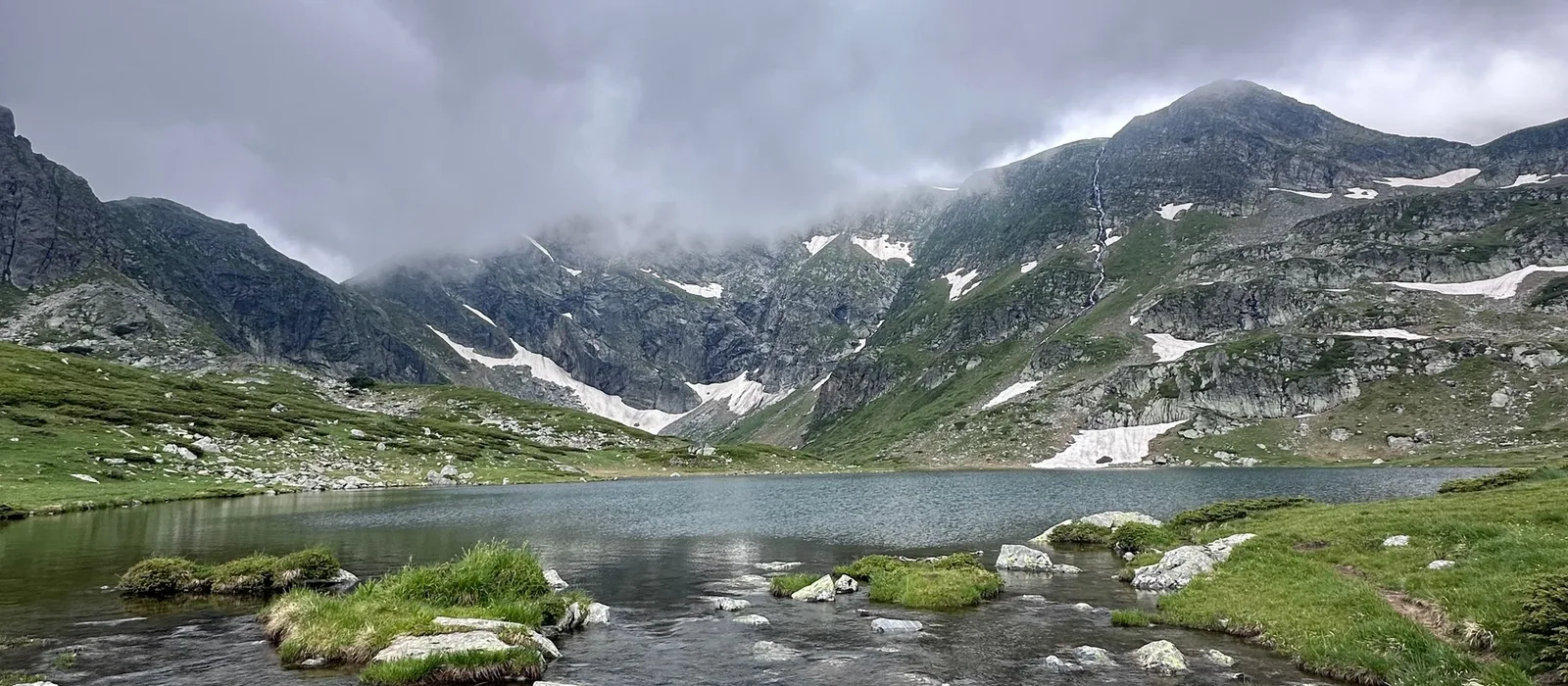
Our destination for today is an absolute natural gem: the Seven Rila Lakes (Sedemte Rilski Ezera).
These glacial lakes lie at an altitude of roughly 2,100 to 2,500 metres above sea level and are considered a sacred place by the so-called White Brotherhood, followers of the mystic Peter Deunov, who gather here in August to perform ritual dances dressed in white.
Which, I have to admit, reminded me a little of the horror film Midsommar :D.
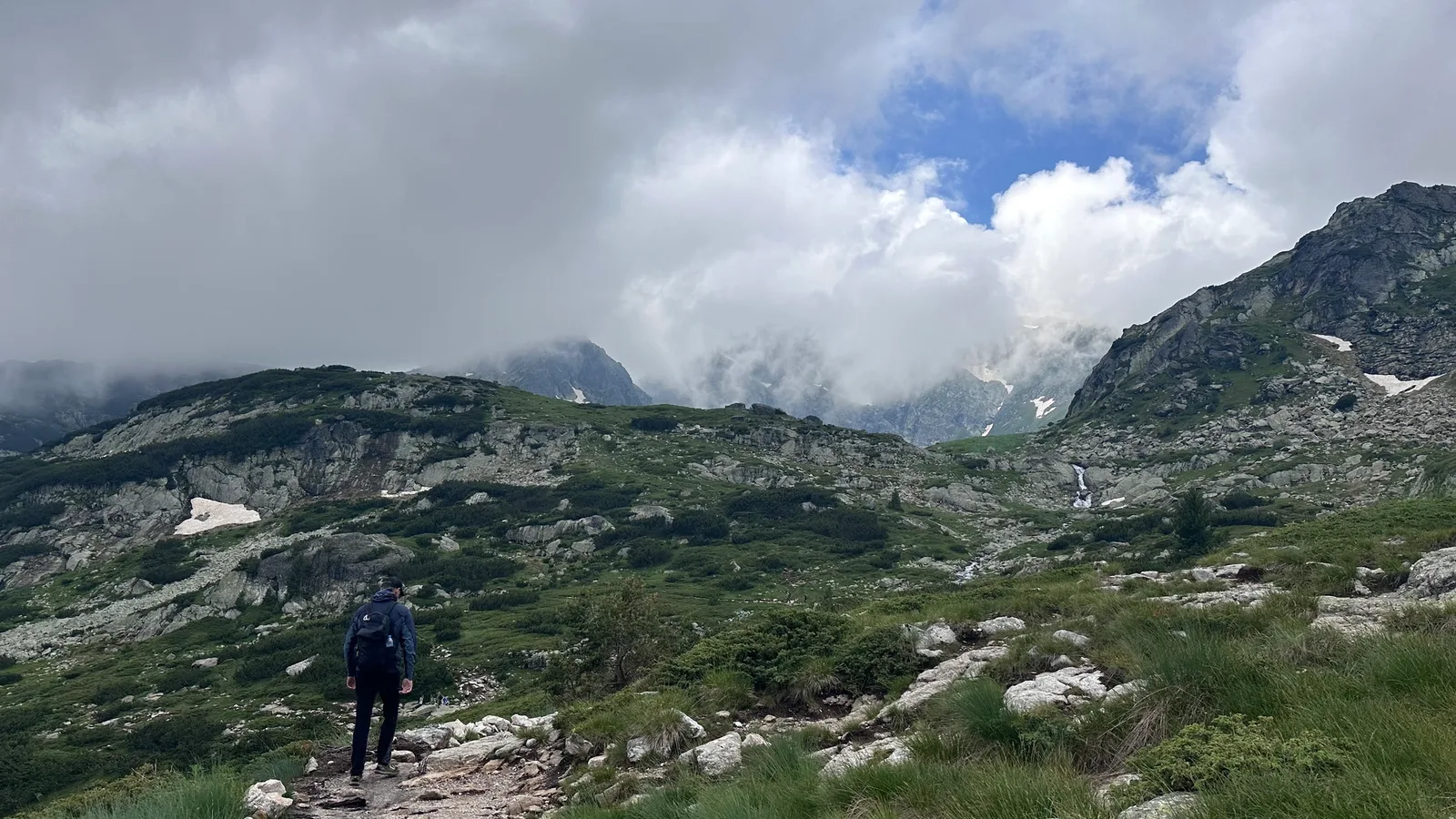
A steep, rocky and uncompromising trail awaits us.
The route initially leads through a dense forest, where we tackle a sharp ascent over roots and boulders.
Along the way, we meet mushroom pickers carrying enormous porcini mushrooms in their buckets — almost as if they had been collecting them somewhere in Chernobyl’s Red Forest :D.
But after just under two hours, we finally climb above the tree line.
And suddenly, the landscape opens up in front of us and takes our breath away.
These are not the Tatras.
This is Rila.
As people with a huge soft spot for the High Tatras, we immediately experience an intense sense of déjà vu.
The sharp granite peaks. The monumental glacial cirques. The deep, dark-blue eyes of the lakes scattered across different levels of the mountains...
Memories of the final ascent to Rysy or the view into Mengusovská Valley immediately come to mind. The resemblance is almost unbelievable, but with one major difference — there are no crowds here. We were incredibly, almost fairy-tale lucky. Maybe it was the early start, maybe the unstable weather forecast, but we walked the entire route around the lakes practically alone.
Each lake is named after its shape or characteristic:
Dolnoto (The Lower Lake) – the lowest-lying lake.
Ribnoto (The Fish Lake) – the shallowest one, with an old mountain hut standing on its shore.
Trilistnika (The Trefoil) – with its irregular shape.
Bliznaka (The Twin) – the largest lake in the complex.
Bubreka (The Kidney) – with steep banks, the iconic lake.
Okoto (The Eye) – the deepest glacial lake in Bulgaria (37.5 m), almost permanently icy.
Salzata (The Tear) – the highest-lying one (2,535 m), with perfectly crystal-clear water.
On the ridge by Salzata, an icy wind was blowing, but the view was worth every bit of effort. On the way back, we sat down on the ground for a while and simply admired that beautiful view. It is worth it — every single step.
I must not forget that on the way we were once again wearing our favourite things from Fusakle.cz and sunglasses from Neibo.cz.
On the way back, we passed even more breathtaking views. Time stands still here, all worries disappear, and the frown lines on your forehead drift away with the clouds.
On the return route, we walk along the so-called Prayers Hill, with mountain huts in sight, where we stop for a snack and let our legs rest — because they still have the way down ahead of them, without the chairlift!
A Hidden Balkan Gem: Kovacha Guest House in the Village of Raduil
After a full day of trekking, exhausted, we get into the car and drive to the small village of Raduil, still largely untouched by tourism. We have booked our stay at Kovacha Guest House. If you want to experience the real soul of the Balkans, forget sterile hotels. This house is modest and furnished in a traditional rural style, but the hospitality of the owners is truly royal.
After a beer and some food, our eyes are already starting to close and the view is slowly lulling me to sleep. Time to drift off into dreamland. Tomorrow, a little history awaits us.
For breakfast, they prepared a feast we will remember for a long time: homemade freshly baked bread, handmade banitsa — flaky pastry filled with Balkan cheese — homemade ajvar, tomatoes that taste like sunshine, and cheeses straight from local farmers. And of course, mekitsi could not be missing — something like fried dough pastries. They are served with jam and cheese.
All of this for a price that, when converted into Czech crowns, feels almost ridiculously cheap. Time seems to have stopped here, in the best possible way.
Day 3: The Mysticism of Rila Monastery and the Wilderness Beneath Vitosha
In the morning, we say goodbye to Raduil and set off on a longer drive of around two hours through the mountains towards the most sacred and visually breathtaking place in Bulgaria — Rila Monastery (Rilski Manastir).
A UNESCO World Heritage Site where time seems to stand still. The monastery was founded in the 10th century by the hermit Saint Ivan of Rila. What we see today is largely the result of reconstruction after a devastating fire in the 19th century, but the atmosphere of the place still feels ancient.
Because we know it is a major tourist attraction, we deliberately park about 500 metres before the main entrance, along the road in the forest, and walk the rest of the way. This way, we avoid the chaos of the main car park and have a moment to mentally prepare ourselves for this sacred place.
Entrance to the monastery complex itself is free — you only pay for the museums inside or for parking.
Once you pass through the massive stone gate, you find yourself in a courtyard that looks as if it belongs to another world. Black-and-white striped arches, wooden galleries with four levels of monks’ cells, and in the centre stands the Church of the Nativity of the Virgin Mary, completely covered inside and out with breathtaking, colourful frescoes.
They depict heaven, hell, demons and saints in extraordinary detail.
A Stop by a Restricted Reservoir and Then on to Vitosha
After our dose of history, we get back in the car and head to a local restaurant for lunch, where we have excellent trout with fried potatoes. Delicious!
After lunch, we pass one of the large mountain reservoirs in the Rila/Iskar area. Its crystal-clear turquoise water surrounded by forests is incredibly tempting for a swim. The signs around it, however, are uncompromising — swimming is strictly prohibited because the reservoir serves as a source of drinking water for the region.
Even so, it is the perfect place for a fifteen-minute break, a chance to stretch your legs and take a few panoramic photos.
By evening, we reach the destination for the day: Vitosha National Park. This enormous mountain massif, with its highest peak Cherni Vrah at 2,290 metres above sea level, rises directly above the southern edge of Sofia.
We stay right at the foot of Vitosha — from the balcony, we look up towards the green slopes and down towards the twinkling lights of the city.
A perfect combination.
Personally, I cannot really recommend this particular accommodation. It is close to the national park, but there is almost nothing nearby and even the shops are quite far away. The breakfast was probably the weakest of all the places we stayed.
But of course, accommodation is a very individual matter.
I will not be too critical, though, because Boyana Church (Boyanska tsarkva), modestly hidden in a dense wooded park at the foot of the mountain, is also a beautiful sight.
This small medieval Orthodox church is listed as a UNESCO World Heritage Site for a fascinating reason. Its interior frescoes date back to 1259. The realism, emotional depth in the faces of the saints and detailed anatomy were a good hundred years ahead of the Italian Renaissance.
Standing inside this small space, you are touching the very roots of European art.
And when you step outside into the garden, another surprise awaits.
Towering above you are giant sequoias (Sequoiadendron giganteum).
These North American conifers, which you would expect to see in California rather than in the Balkans, were personally planted here in the early 20th century by Bulgarian Tsar Ferdinand I.
Today, these giants majestically guard the centuries-old history of the place and add to its unique mystical atmosphere.
And I cannot wait to see giant sequoias with my own eyes this autumn in the USA.
Day 4: Sofia – The Most Beautiful and Most Underrated Capital in the Balkans
We dedicate the final morning of our long weekend to exploring the historic centre of Sofia.
And we have to admit something right from the start:
Without hesitation, we rank Sofia among the most beautiful and most interesting capital cities in the entire Balkans.
If you are expecting a grey, crumbling post-Soviet metropolis, you are in for a huge surprise.
While walking through the centre, we come across the monumental Presidential Palace.
Directly in front of the main entrance stands an honour guard dressed in traditional historic uniforms with white feathers on their hats.
The changing of the guard, which takes place every hour on the hour, is an incredibly precise and elegant spectacle and something you should not miss if you want a great video for social media.
Sofia is an incredibly clean and green city, with boulevards lined with yellow ceramic paving stones — the famous Yellow Pavement, said to have been a gift from the Austro-Hungarian emperor.
What fascinates us most is the so-called Square of Tolerance right in the heart of the city.
Within an area of just a few hundred metres, four major places of worship have stood side by side in peace for centuries: the Orthodox Church of St Nedelya, Banya Bashi Mosque, Sofia Synagogue and the Catholic Cathedral of St Joseph.
Roman Ruins in the Metro and Golden Domes
When you enter the metro at Serdika station, you do not find yourself in some boring underground passage.
Instead, you walk straight into the excavated ruins of the ancient Roman city of Serdica, dating from the 2nd to the 4th century.
You cross glass walkways directly above ancient streets and structures.
The crowning glory of the city, however, is the monumental Alexander Nevsky Cathedral.
This Neo-Byzantine cathedral, with its enormous domes covered in real gold, can accommodate up to 10,000 people and is one of the largest Orthodox churches in the world.
For a while, you simply sit there and absorb the peace and silence.
Sometimes we all need that — to be alone.
Just a few streets away, another architectural gem appears in front of us, looking as if it has been taken straight out of a Russian fairy tale — the Church of St Nicholas the Miracle-Maker, often simply called the Russian Church.
Its five onion-shaped domes are covered in pure gold, shining brightly in the Balkan sun, while the walls are decorated with beautiful colourful majolica tiles.
Time is against us, so we only manage this quick historical tour of the city. But we already know that we have to come back.
Sofia deserves at least one or two full days to properly explore the National History Museum, its excellent independent coffee scene and hidden streets filled with street art.
Where to stay?
1.
2.
3.
TikTok moment

Discussion
Comments
No comments yet. Be the first to share your thoughts.