
The Bohemian Paradise (Český ráj) hides incredibly beautiful nature.
This loop trail from Malá Skála to the ruins of Rotštejn Castle also surprised us by how few people we met along the way. On a route about 16 kilometers long – maybe a bit more depending on all of our detours – we walked virtually alone most of the time. What lay ahead of us were small villages, fresh burčák (young wine) to keep our energy up, fruit from the trees along the path, distant views, and a dramatic finale among the Suché skály (Dry Rocks), which are nicknamed the Czech Dolomites.
And that very last part of the trip was the absolute best. Sharp rock spires, climbers high above the ground, yellow lichens on the stones, and to top it all off, a descent down a wooden ladder. If you are looking for a longer hiking loop in the Bohemian Paradise that combines historical sights, villages, scenic views, and a bit of adventure, this route from Malá Skála is definitely worth your attention.
Note: The time mentioned above is just an estimate. We stopped along the way, took in the views, and were definitely not hiking for peak performance. If you want to explore Rotštejn, take photos, or spend some time watching the climbers on Suché skály, make sure to leave yourself plenty of time.
From Prague to Malá SkálaWe set off from Prague by car and arrived in Malá Skála in about an hour and a half. We parked right in the village at the parking lot by the bridge over the Jizera River. At the time of our visit, we paid just 50 CZK for the entire day. While parking prices may change, this spot is incredibly practical as a starting point – once you return from the rocks, you will find yourself right back at your car.
Malá Skála is one of the most beautiful starting points in the Bohemian Paradise. It lies in the Jizera Valley and is surrounded by rocky ridges, meaning interesting spots begin practically on both sides of the river. Most visitors head towards Pantheon, Frýdštejn Castle, or take the shorter loop through Suché skály. This time, however, we mapped out a longer route to the ruins of Rotštejn Castle.
Check out the video from this beautiful day:
TikTok moment
Video moment z cesty
Malá skála trailHeading to Rotštejn via the Back Roads
Instead of taking the shortest forest path from Malá Skála to Rotštejn, we intentionally chose a route along the quiet back roads winding through the surrounding villages. We wanted to lengthen our loop and explore places that most tourists only catch a glimpse of through a car window.
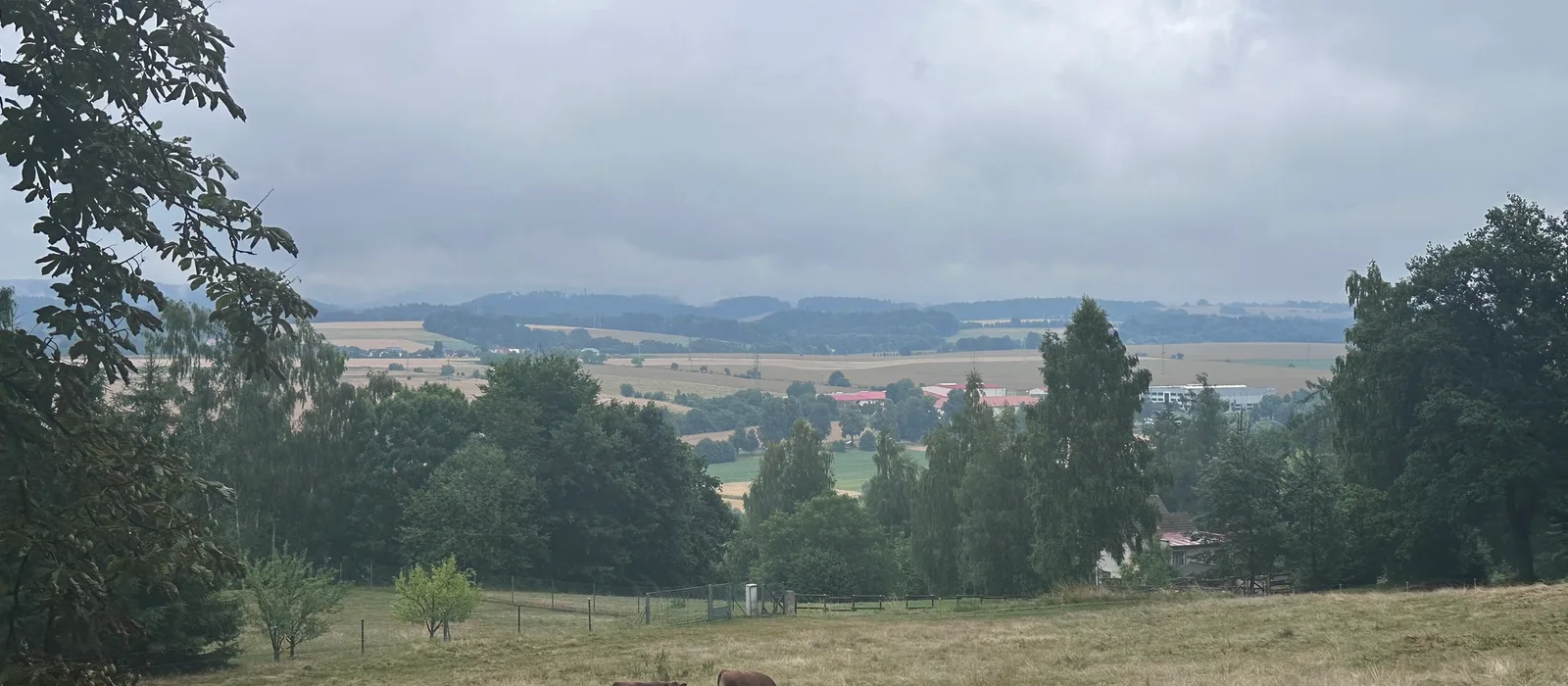
While a stretch of road walking might not look like the biggest adventure on a map, it actually had a wonderfully pleasant atmosphere. We walked through a peaceful countryside, passing houses, meadows, and orchards, and encountered barely anyone. Fruit was ripening right by the road, so we brightened our trek with a few sweet pieces. And since we set off during the young wine season, we even stumbled upon a chance to recharge our batteries the Moravian way – with a cup of burčák (partially fermented grape juice). It might not be your traditional sports drink recommended for mountain hikes, but it definitely boosted our spirits!
Views of Trosky, Ještěd, and Bezděz
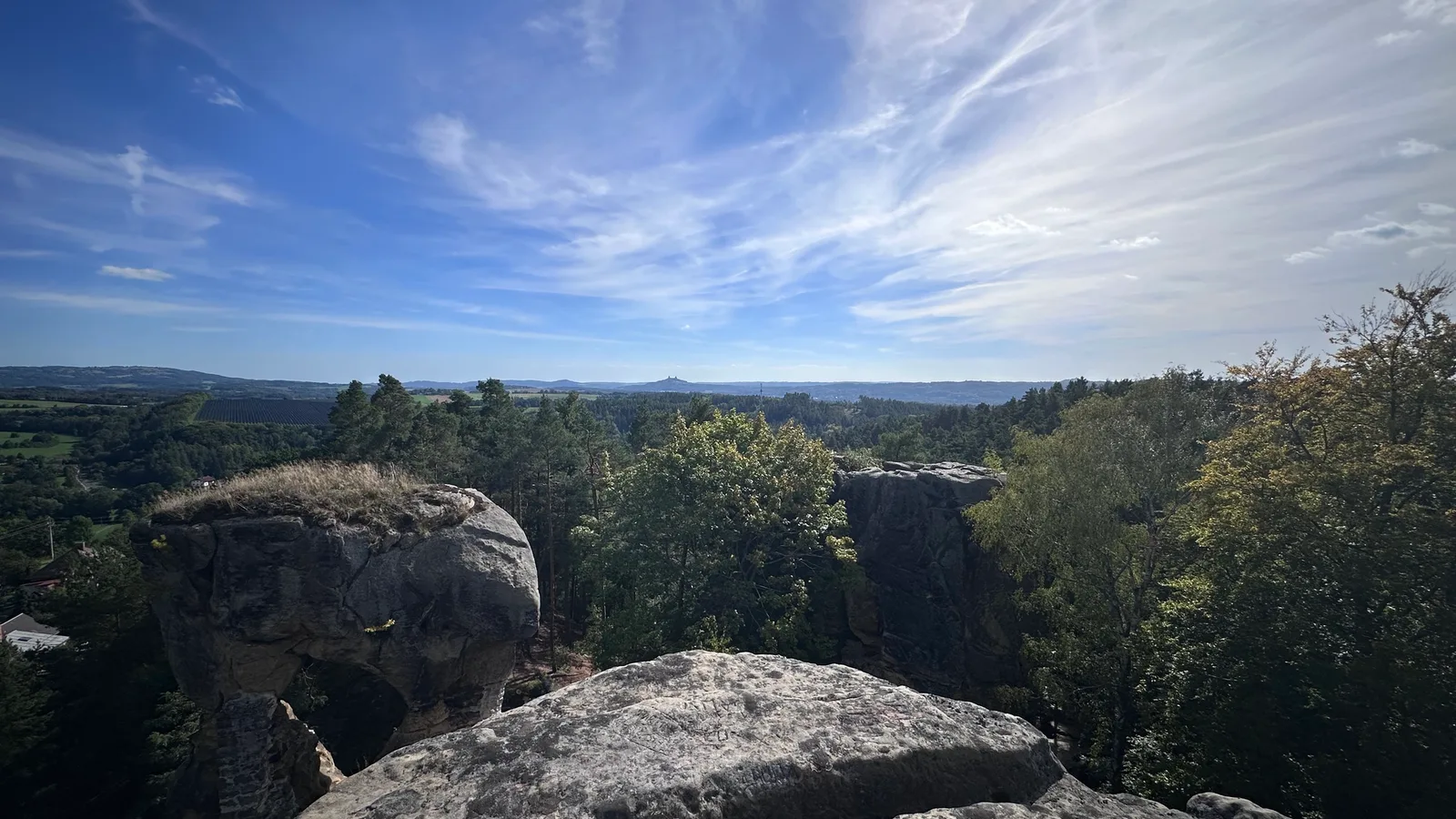
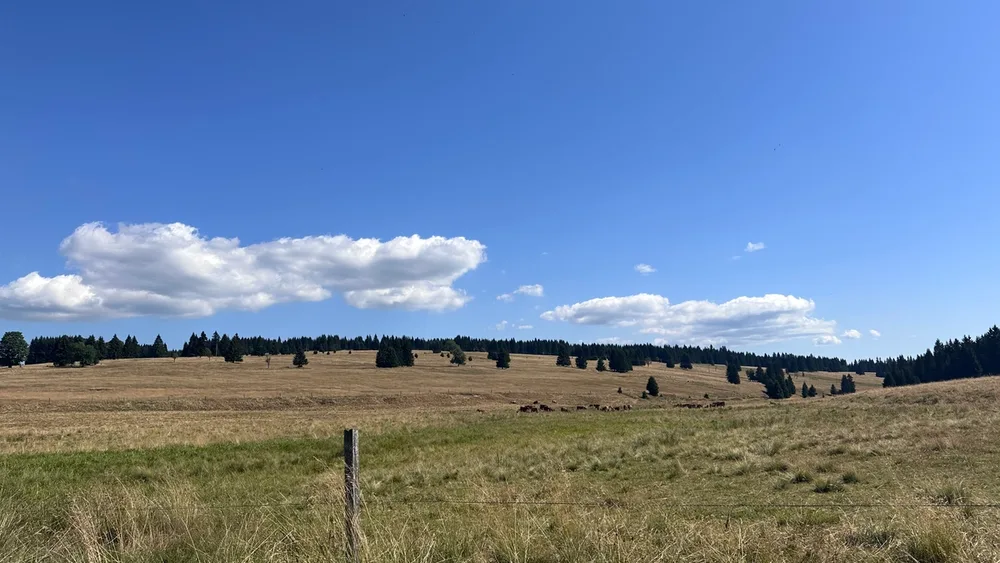
As we gained elevation, the landscape began to open up, offering unexpectedly distant views. In the distance, we could make out the distinct silhouettes of Trosky Castle, Ještěd, and Bezděz Castle. These are exactly the kinds of spots we love most on longer hikes – it's not just about reaching the main destination, but about those little moments along the way that constantly make you pause to spot another familiar landmark on the horizon.
Of course, the views depend heavily on the weather and visibility. But on a clear day, the area around Malá Skála feels like an open map of Northern and Eastern Bohemia.The Ruins of Rotštejn Castle Hidden in the RocksRotštejn is not your typical ruin standing out on a bare hilltop. The castle was partly built on and partly carved directly into four sandstone rock formations. It is this fusion of human architecture and natural stone that gives the place its unique atmosphere. At first glance, it might not seem as massive as other famous Czech castles, but looking closer, you start discovering rooms, corridors, and other traces of the people who once lived here carved right into the stone.
Preserved parts of the castle include walls of the palace, a black kitchen, a section of a corridor, a well, and chambers hollowed out of the sandstone. While exploring the site itself won't take up your whole day, it serves as the perfect destination for a longer trek.A Brief History of RotštejnThe castle was founded in the mid-13th century as the family seat of the Markvartic noble family. Part of the structure was carved into sandstone blocks, while other sections were made of masonry and wood. Following a fire in 1318, Rotštejn was rebuilt, gaining a large stone palace and a prominent tower topped with a multi-story half-timbered extension.
By the beginning of the 16th century, the castle was already abandoned. However, its story didn't end there. From the 17th century onwards, locals began carving living quarters, stables, and cellars into the base of the rocks. Some of these spaces were still in use as late as the end of the 19th century. This makes Rotštejn fascinating not only as a remnant of an aristocratic castle, but also as a site of later rock-cut dwellings.
Note: The inner part of the castle is accessible only during the designated season and in dry weather. For safety reasons, it may remain closed during rain, strong winds, and for several hours afterward. It is best to check the current opening hours on the official website of Rotštejn Castle.
Heading Back to Malá Skála Through the Forest
From Rotštejn, we switched gears and headed back towards Malá Skála along forest paths. After doing quite a bit of walking on roads earlier, this was a welcome change of pace. All the background noise virtually vanished; the trail wound its way through the trees, and at times, it felt like we had the entire forest all to ourselves.
This half of the loop trail was more varied and a bit more technical. We encountered more roots, stones, and narrower paths. Sandstone and wood can become notoriously slippery when wet, so wearing a pair of sturdy hiking boots definitely pays off here, even though it is not a high-altitude mountain trek.
Gradually, we approached the most striking landmark of the entire Malá Skála region – the Suché skály (Dry Rocks).
Suché skály – The Czech Dolomites
Suché skály used to be known as Kantorovy varhany (The Kantor’s Organs), and due to their sharp, jagged shapes, they are often called the Czech Dolomites. For once, the nickname is not an exaggeration. Slender sandstone spires rise dramatically out of the ground, resembling stone organ pipes or the spine of a dragon from certain angles.
Their unusual shape is a result of the Lusatian Fault. The originally horizontal layers of hard sandstone were pushed into a nearly vertical position by geological movements. Today, the ridge is divided into roughly twenty distinct rock towers. Suché skály has been a protected area since 1965 and currently holds the status of a National Natural Monument.
Suché skály is also a hotspot for rock climbing. As we walked through, the towers and bases were buzzing with climbers. All we had to do was look up to spot climbers scattered across the rocks at various heights. Yet, despite this, the actual hiking trail never felt overcrowded.The rocks were covered in yellow lichens and moss, adding vibrant pops of color to the sharp grey walls. After our peaceful trek through villages and forests, this grand finale among the rocky spires felt like a completely different trip.
A Ladder to Finish and the Descent into Malá SkálaPassing through Suché skály is made even more exciting by wooden ladders. On our loop, the best one came right near the very end – an awesome descent tucked between the rocks, after which we continued our way down into Malá Skála.
While this is not a via ferrata or an extremely dangerous section, anyone with a fear of heights or those hiking with small children might want to take their time here. We wouldn’t recommend this part of the route in the rain. Wet wood, roots, and sandstone can get incredibly slick, and the castle itself is usually closed during bad weather anyway.
After the descent, all that was left was to head back down into the Jizera Valley and return to the parking lot. We had about 16 kilometers – maybe even a bit more – in our legs, but thanks to the constant shift between villages, scenic overlooks, a castle, forests, and rocks, the time flew by.
Who Is This Loop Suitable For?
We highly recommend this route to hikers who want to spend most of their day outdoors and don't mind a mix of asphalt, forest paths, and more technical rocky sections. It is not suitable for strollers, and because of the ladders, it might not be ideal for every dog. If you are hiking with a larger dog, you need to consider beforehand whether you can safely get them down through the technical spots.
The biggest physical challenge isn't one single steep climb, but rather the total distance and the rugged finale. In dry weather, any moderately fit hiker can handle it. In wet conditions, however, the difficulty increases significantly.
What to Pack
- Sturdy hiking shoes with a non-slip sole.
- Plenty of water and snacks – treat the burčák only as a pleasant bonus.
- An offline map or a hiking app.
- Cash for parking, light refreshments, and potential castle admission.
- A light waterproof layer in case the weather is unpredictable.
- Trekking poles if they help you with longer descents – though you will have to pack them away when climbing the ladders.
Why We Loved This Trip
The loop from Malá Skála to Rotštejn via Suché skály combines several completely different trips into a single day. First, you walk through quiet villages and open countryside, tasting fresh fruit or young wine. Then, you discover a medieval castle carved into the rocks, and finally, you return through a forest surrounded by the sharp spires of the Czech Dolomites.T
he biggest surprise for us was how few people we met along most of the route. While the most famous spots in the Bohemian Paradise tend to be crowded, we enjoyed long stretches between Malá Skála and Rotštejn almost entirely to ourselves. It only got a bit busier near Suché skály, and even there, it was mostly rock climbers rather than crowds of tourists.
So, if you are looking for a full-day trip from Prague where you can get a great workout, see a piece of history, enjoy distant views, and experience one of the most striking rock landscapes in the Bohemian Paradise, this loop is an excellent choice.
FAQ
How long is the route from Malá Skála to Rotštejn via Suché skály?
Depending on your chosen paths and detours, expect about 16–18 kilometers. It is a full-day loop trail that starts and ends in Malá Skála.
Where can I park in Malá Skála?
We parked at the parking lot by the bridge over the Jizera River. At the time of our visit, all-day parking cost 50 CZK. Be sure to check the current price on-site.
Is the loop through Suché skály difficult?
The route is moderately challenging, mainly due to its length, tree roots, rocky sections, and wooden ladders. It can be significantly more difficult when wet.
Is Rotštejn Castle open all year round?
The inner grounds of the castle are open during the tourist season and only in favorable, dry weather. The surrounding hiking trails remain accessible outside of opening hours, provided current conditions allow it.
Why are the Suché skály called the Czech Dolomites?
Because of their sharp, jagged rock towers that resemble mountain peaks. In the past, they were also known as Kantorovy varhany (The Kantor’s Organs).


Discussion
Comments
No comments yet. Be the first to share your thoughts.